Commercial Excellence in the Agentic Age: A Pedagogical Framework for Executive Education in Algorithmic Commerce
Paul F. Accornero
Affiliations
Founder, The AI Praxis
ORCID ID: https://orcid.org/0009-0009-2567-5155
SSRN Working Paper Series: SSRN https://ssrn.com/abstract=5999474
Date: January 2026
Comments welcome: paul.accornero@gmail.com
WORKING PAPER
This is a pre-print version of a more in-depth paper undergoing peer review.
Contact: paul.accornero@gmail.com
Abstract
This paper develops a pedagogical framework for integrating Commercial Excellence disciplines with Agentic Commerce theory in executive education. Drawing on andragogical principles (Knowles, 1984), transformative learning theory (Mezirow, 1991), and the reflective practitioner tradition (Schön, 1983), I argue that the emerging paradigm of algorithmic commerce—where AI agents assume purchasing functions previously held by humans—requires fundamental curriculum innovation in business education. Commercial Excellence—encompassing Commercial Policy, Revenue Growth Management, and retail execution frameworks—has been extensively developed in consulting practice (McKinsey, BCG, Bain, Simon-Kucher) but remains largely absent from academic curricula. Simultaneously, my theoretical work on the 'Shopper Schism' (Accornero, 2025a) identifies a structural transformation that current management education does not address. Synthesising 25+ years of global commercial leadership experience with original research on algorithmic commerce, this paper makes three contributions. First, it provides the first academic codification of Commercial Excellence as an integrated discipline suitable for executive education. Second, it establishes the theoretical bridge between established commercial practice and emerging algorithmic commerce theory. Third, it proposes a modular curriculum architecture grounded in adult learning theory, constructive alignment (Biggs, 1996), and the pracademic integration model that addresses calls for relevance in management education (Pfeffer & Fong, 2002; Bennis & O'Toole, 2005). The framework responds to critiques of business education's disconnect from practice (Mintzberg, 2004) while maintaining academic rigour through theoretical grounding. Implications for business school curriculum design, executive education programme development, and the scholarship of management teaching are discussed.
Keywords: Executive Education; Management Learning; Commercial Excellence; Agentic Commerce; Shopper Schism; Andragogy; Transformative Learning; Curriculum Design; Pracademic; Algorithmic Commerce; Business School Pedagogy
1. Introduction
Business education faces a persistent critique: its disconnect from the realities of managerial practice (Pfeffer & Fong, 2002; Bennis & O'Toole, 2005; Mintzberg, 2004). While this critique has generated extensive debate about pedagogical reform, a more fundamental challenge now emerges. The commercial environment itself is undergoing structural transformation that existing curricula—however reformed—do not address. When artificial intelligence agents assume purchasing functions previously held by humans, the entire edifice of marketing, sales, and commercial strategy requires reconceptualisation. Business schools have built sophisticated curricula addressing digital transformation, marketing analytics, and AI applications—important advances that reflect genuine responsiveness to technological change. Yet the structural transformation now emerging may require a different order of curriculum evolution. Current offerings largely treat AI as a tool that enhances human decision-making; the Shopper Schism suggests AI is becoming a decision-maker itself. This is not a critique of what business schools have accomplished but an observation about what the commercial environment now demands. The opportunity is to build on existing strengths—rigorous analytical frameworks, case-based learning, executive development expertise—while extending curricula to address a paradigm shift that few institutions have yet confronted directly.
This paper addresses both challenges simultaneously. It develops a pedagogical framework that responds to calls for practice-relevance in management education while addressing the structural transformation of commerce itself. The framework integrates two domains: Commercial Excellence—the established disciplines of commercial policy, revenue management, and retail execution that consulting firms have developed but business schools have not codified—and Agentic Commerce—my theoretical work on how AI agents are restructuring commercial exchange (Accornero, 2025a, 2025b, 2025c).
The integration is grounded in adult learning theory. Knowles' (1984) andragogical principles emphasise that adult learners bring experience that serves as a resource for learning, require relevance to immediate professional challenges, and learn best through problem-centred rather than subject-centred approaches. Mezirow's (1991, 2000) transformative learning theory describes how adults revise meaning structures when confronted with 'disorienting dilemmas' that challenge existing assumptions. The transition from human-centric to algorithm-centric commerce represents precisely such a disorienting dilemma—one that requires not incremental skill acquisition but fundamental reconceptualisation of commercial practice.
My analysis of executive education offerings across leading business schools reveals a striking gap: no programme currently integrates Commercial Excellence frameworks with Agentic Commerce theory. Schools are adding 'AI for Marketing' courses that treat artificial intelligence as a productivity tool—how to use ChatGPT for content creation, how to apply machine learning to customer segmentation. These additions perpetuate rather than challenge the assumption that humans remain the purchasing decision-makers. They teach 'Digital Transformation 1.0' when the commercial environment demands preparation for what I term 'Commercial Transformation 2.0'—the structural shift where the customer becomes the algorithm.
The paper proceeds as follows. Section 2 examines the theoretical foundations for curriculum design, drawing on andragogy, transformative learning, and the scholarship of management education. Section 3 presents Commercial Excellence as an established domain awaiting academic codification. Section 4 summarises the Agentic Commerce theoretical framework. Section 5 develops the integration model and modular curriculum architecture. Section 6 addresses pedagogical implementation through what I term the 'Pracademic Method.' Section 7 discusses contributions, limitations, and implications for management education scholarship.
2. Theoretical Foundations for Executive Education Curriculum Design
2.1 Andragogy and Adult Learning Principles
Knowles' (1984) theory of andragogy provides foundational principles for executive education design. Unlike pedagogy's assumptions about dependent learners acquiring predetermined content, andragogy recognises that adults are self-directed, bring substantial experience to learning contexts, require relevance to life situations, and are motivated by internal factors including professional development and self-actualisation. These principles have profoundly shaped executive education practice, though their application often remains implicit rather than theoretically grounded (Forrest & Peterson, 2006).
Five andragogical assumptions guide curriculum design for the present framework. First, adults need to understand why they need to learn something before undertaking to learn it. The Shopper Schism thesis provides this 'why'—executives must understand algorithmic commerce not as an interesting development but as an existential challenge to their organisations' commercial viability. Second, adults maintain a self-concept of being responsible for their own decisions. The modular curriculum architecture respects this autonomy, enabling participants to engage with content relevant to their specific contexts. Third, adults enter educational activities with greater volume and different quality of experience than youth. The framework explicitly draws on participant experience through structured reflection and application exercises. Fourth, adults become ready to learn when they experience a need to know or do something to perform more effectively. The industry momentum toward agentic commerce—McKinsey's projections, Visa and Mastercard's Agent Pay launches, Google's protocols—creates this readiness. Fifth, adults are life-centred in their orientation to learning. Every framework component connects to immediate professional application.
Kolb's (1984) experiential learning cycle complements andragogical principles by describing learning as a cyclical process of concrete experience, reflective observation, abstract conceptualisation, and active experimentation. Executive education that engages only abstract conceptualisation—the traditional lecture format—fails to complete the learning cycle. The present framework incorporates all four modes: case discussions provide vicarious concrete experience; structured reflection exercises enable reflective observation; theoretical frameworks offer abstract conceptualisation; and application projects support active experimentation.
2.2 Transformative Learning and Paradigm Shift
Mezirow's (1991, 2000) transformative learning theory addresses how adults change fundamental meaning structures—the taken-for-granted frames of reference through which they interpret experience. Transformative learning typically begins with a 'disorienting dilemma' that cannot be resolved within existing meaning structures. It proceeds through critical reflection on assumptions, exploration of alternative perspectives, and eventual perspective transformation that enables new ways of understanding and acting.
The transition from human-centric to algorithm-centric commerce constitutes a disorienting dilemma for commercial executives. Careers have been built on frameworks—brand building, customer relationship management, sales force effectiveness—that assume human purchasing decision-makers. The Shopper Schism challenges these assumptions at their foundation. If the shopper is no longer human, what becomes of persuasion-based marketing? If algorithms select products based on data quality rather than brand equity, what becomes of the brand investment? These questions cannot be answered within existing meaning structures; they require perspective transformation.
Transformative learning theory suggests that such perspective transformation requires specific conditions: a safe environment for questioning assumptions, access to alternative perspectives, opportunity for dialogue and critical reflection, and support for action based on new understanding (Taylor, 2007). The curriculum framework incorporates these conditions through structured peer discussion, exposure to the Agentic Commerce theoretical framework as an alternative perspective, facilitated critical reflection on current practice, and action planning for organisational application.
Cranton (2006) extends transformative learning theory to professional contexts, arguing that professional development often requires transformation of professional identity—not merely acquisition of new skills but reconceptualisation of professional role and purpose. For commercial executives, the Agentic Commerce transformation may require such identity revision: from 'persuader of human customers' to 'architect of algorithmic interfaces,' from 'brand builder' to 'data infrastructure strategist.' The curriculum must support this identity work, not merely deliver content.
2.3 Constructive Alignment and Curriculum Architecture
Biggs' (1996, 2003) principle of constructive alignment provides the architectural logic for curriculum design. Constructive alignment requires that intended learning outcomes, teaching and learning activities, and assessment tasks are systematically aligned. When these elements cohere, students are 'trapped' into engaging appropriately with the intended outcomes. Misalignment—common in traditional curricula—produces surface learning where students engage strategically with assessment requirements rather than substantively with intended learning.
The present framework applies constructive alignment at multiple levels. At the programme level, the intended outcome is transformation of commercial leadership capability for algorithmic environments. Teaching activities progress from foundation-building through paradigm introduction to implementation planning—a sequence that supports the transformative journey. Assessment (where applicable in formal academic contexts) centres on application to participants' organisational contexts rather than reproduction of content.
At the module level, each component specifies learning outcomes using Bloom's (1956) taxonomy as refined by Anderson and Krathwohl (2001). Foundation modules target comprehension and application of Commercial Excellence frameworks. Transformation modules target analysis and evaluation of current practice against Agentic Commerce implications. Implementation modules target synthesis and creation of organisational response strategies. This progression from lower-order to higher-order cognitive engagement reflects both Bloom's hierarchy and the transformative learning journey from existing understanding through critical reflection to new perspective and action.
Wiggins and McTighe's (2005) 'backward design' methodology complements constructive alignment by beginning curriculum development with desired results, then determining acceptable evidence of achievement, and only then planning learning experiences. The present framework was developed through this backward design process: beginning with the question 'what must commercial leaders understand and be able to do in an algorithmic commerce environment?' and working backward to the curriculum architecture that would produce such outcomes.
2.4 The Relevance Crisis in Management Education
The curriculum framework responds to a sustained critique of management education's disconnect from practice. Pfeffer and Fong (2002) documented the weak relationship between business school education and career success, questioning whether business schools produce graduates capable of effective management. Bennis and O'Toole (2005) argued that business schools have adopted a scientific model inappropriate for a professional discipline, prioritising research rigour over practical relevance. Mintzberg (2004) contended that MBA programmes fundamentally misconceive management, attempting to teach leadership in classrooms divorced from the contexts where leadership occurs.
These critiques stimulated reform efforts including increased emphasis on experiential learning, integration of practice-based faculty, and development of action learning programmes (Datar, Garvin, & Cullen, 2010). Yet Moldoveanu and Narayandas (2019) argue that executive education requires more fundamental transformation: from content delivery to capability building, from standardised programmes to personalised learning journeys, from classroom instruction to technology-enabled continuous development.
The present framework addresses relevance through multiple mechanisms. It brings practitioner knowledge—the Commercial Excellence frameworks developed through consulting engagement—into academic discourse. It connects theoretical contribution—the Agentic Commerce framework—to immediate professional challenges. It employs pedagogical approaches grounded in adult learning theory rather than transplanted from undergraduate education. Most fundamentally, it addresses a transformation that participants can observe in their professional environments, ensuring that content relevance is experientially validated rather than merely asserted.
3. Commercial Excellence: Industry Practice Awaiting Academic Codification
3.1 The Development of Commercial Excellence in Consulting Practice
Commercial Excellence emerged as a management consulting discipline during the 1990s, representing the codification of best practices in go-to-market strategy, pricing, and sales effectiveness. Simon-Kucher & Partners, founded in 1985 and widely recognised as pioneers in pricing strategy, developed integrated frameworks combining pricing science, sales force effectiveness, and marketing optimisation (Simon-Kucher & Partners, 2021). McKinsey & Company's extensive practice in revenue management and commercial transformation has generated substantial practitioner literature (McKinsey & Company, 2019). Bain & Company's work on customer strategy informs industry approaches to commercial effectiveness (Bain & Company, 2020). Boston Consulting Group addresses go-to-market excellence and pricing analytics (BCG, 2022). Kearney has developed sector-specific frameworks for consumer goods commercial effectiveness (Kearney, 2021). Deloitte's practice focuses on revenue optimisation and sales transformation (Deloitte, 2020). EY-Parthenon addresses commercial strategy within broader corporate transformation (EY-Parthenon, 2021). PwC's commercial effectiveness work spans pricing, promotion, and revenue management (PwC, 2020).
These consulting practices share common architectural elements that constitute the Commercial Excellence domain. Commercial Policy establishes governance frameworks for customer relationships, pricing authority, and terms of trade. Revenue Growth Management (RGM) applies analytical rigour to pricing, promotion, and portfolio decisions. Retail execution frameworks—whether 'Perfect Physical Shelf' for physical retail or 'Perfect Virtual Shelf' for digital commerce—codify operational standards for in-market execution. The vocabulary has become industry standard: net revenue management, price-pack architecture, promotional ROI, category captaincy, share of shelf.
3.2 The Four Pillars of Commercial Excellence
Synthesising across consulting literature and industry practice, Commercial Excellence can be organised into four integrated pillars that form the foundation module of the curriculum framework:
Pillar 1: Commercial Policy and Price Governance. This pillar establishes the structural framework within which commercial transactions occur. It encompasses customer segmentation and tiering, pricing authority matrices, terms and conditions governance, channel access management, and counterparty risk assessment. The objective is to create coherent, defensible commercial structures that optimise revenue while managing complexity and risk. Comprehensive commercial policy architecture typically addresses six elements: customer classification and segmentation; pricing authority and governance; terms of trade standardisation; promotional guardrails; channel access criteria; and compliance and monitoring mechanisms.
Pillar 2: Revenue Growth Management (RGM). RGM represents the analytical engine of Commercial Excellence, applying quantitative rigour to pricing decisions, promotional investments, and portfolio architecture. Core components include price elasticity analysis and optimal pricing, promotional effectiveness measurement and optimisation, price-pack architecture design, mix management and portfolio optimisation, and trade investment analytics. The evolution from 'trade spending' to 'trade investment' reflects RGM's contribution: treating commercial expenditure as investment requiring rigorous return analysis.
Pillar 3: Perfect Physical Shelf (Physical Retail Execution). Perfect Store frameworks codify execution standards for physical retail environments through what practitioners term the 'Four Ps of Shelf Execution': Presence (product availability and distribution); Placement (shelf positioning, share of shelf, and adjacencies); Persuasion (in-store communication, point-of-sale materials, and merchandising); and Promotion (promotional execution, pricing compliance, and display activation). Perfect Store programmes establish 'Picture of Success' standards for each retail format and measure compliance through systematic field auditing.
Pillar 4: Perfect Digital Shelf (Digital Commerce Execution). As commerce has migrated online, Perfect Store frameworks have been extended to digital environments. Perfect Digital Shelf addresses the 'virtual shelf' with equivalent rigour: search visibility (organic and paid positioning), content quality (product detail pages, imagery, and enhanced content), ratings and reviews (consumer feedback management), and availability and pricing (stock status and price competitiveness monitoring). Perfect Digital Shelf execution requires real-time data capabilities that extend beyond traditional retail expertise.
3.3 The Academic Gap in Commercial Excellence
Despite Commercial Excellence's ubiquity in industry practice, it remains remarkably absent from formal business school curricula. Systematic review of executive education offerings at Financial Times top-25 business schools reveals no dedicated 'Commercial Excellence' programme at any institution. Individual components exist in isolation: pricing courses at Wharton, sales strategy at Kellogg, negotiation at Harvard—but none integrate the complete Commercial Excellence architecture as a coherent discipline.
This gap reflects the broader tension between Mode 1 knowledge (traditional academic knowledge produced in disciplinary contexts) and Mode 2 knowledge (knowledge produced in contexts of application) identified by Gibbons et al. (1994). Commercial Excellence represents Mode 2 knowledge par excellence: developed through client application, refined through practical implementation, protected as intellectual property rather than published for scholarly debate. Van de Ven's (2007) engaged scholarship model suggests that such practitioner knowledge requires translation for academic contexts—precisely what the present framework attempts.
The consequence for executive education is significant. Executives seeking Commercial Excellence development must engage consulting firms directly or rely on internal corporate programmes. Business schools cannot offer what they have not codified. The field lacks the theoretical grounding, academic scrutiny, and pedagogical development that formal academic treatment would provide. This paper contributes the first such academic codification.
4. The Agentic Commerce Theoretical Framework
4.1 The Shopper Schism Thesis
The Shopper Schism describes the structural separation between the human who consumes and the algorithm that purchases (Accornero, 2025a). For over a century, marketing theory assumed these roles were fused in a single human actor. The consumer who desired a product was the same person who searched, evaluated, and purchased. The AIDA model (Strong, 1925), the marketing funnel, customer journey mapping (Lemon & Verhoef, 2016)—all presume this fusion.
AI shopping agents break this fusion. When algorithms evaluate, select, and purchase on behalf of humans, the consumer and shopper become structurally distinct actors with potentially divergent characteristics and vulnerabilities to influence. The human retains the consumer role—experiencing and deriving utility from products. The algorithm assumes the shopper role—processing information, evaluating alternatives, executing transactions. This structural separation—the Shopper Schism—transforms commercial exchange at its foundation.
Three boundary conditions determine where the Shopper Schism operates (Accornero, 2026): the delegation condition (a human delegates purchase decision authority to an algorithmic agent); the intermediation condition (the algorithm interposes itself between human and commercial counterparties); and the optimisation condition (the algorithm applies computational logic to select among alternatives). Where these conditions hold, Shopper Schism mechanisms operate across industry contexts—a universality demonstrated through extension to tourism, public relations, and professional services.
4.2 Agent Intent Optimisation and Related Constructs
The Shopper Schism generates several theoretical constructs that inform curriculum content. Agent Intent Optimisation (AIO) describes the emerging discipline of optimising for algorithmic selection rather than human persuasion (Accornero, 2025b). Where SEO addresses human search behaviour, AIO addresses computational decision logic. Empirical validation through computational simulation demonstrates that operational factors (data quality, API accessibility, integration reliability) exert substantially greater influence on agent selection than traditional brand metrics—a fundamental inversion of marketing's value hierarchy.
The Trust Paradox describes predictable erosion of consumer trust in AI-mediated commerce through a lifecycle of utility-based adoption, monetisation-driven misalignment, and discovery-triggered disillusionment (Accornero, 2025c). The Great Decoupling addresses the separation of brand building from transaction capture when algorithms mediate purchase decisions (Accornero, 2025d). Algorithmic Readiness conceptualises organisational capability to interface with AI agent channels (Accornero, 2025e). The Governance Gauntlet examines regulatory and ethical frameworks for agentic commerce (Accornero, 2025f). These constructs form the theoretical content of the curriculum's transformation module.
5. The Integration Framework and Modular Curriculum Architecture
5.1 The Evolutionary Arc: Foundation, Transformation, Leadership
The central argument of this paper is that Commercial Excellence provides the essential foundation for understanding and navigating the transition to Agentic Commerce. This is not merely pedagogical convenience but reflects structural relationships between the domains. Commercial Excellence frameworks optimise for human purchasing decision-makers. The Shopper Schism transforms these frameworks without making them obsolete—understanding what must change requires understanding current best practice. Executives who lack Commercial Excellence foundations cannot grasp what algorithmic commerce disrupts.
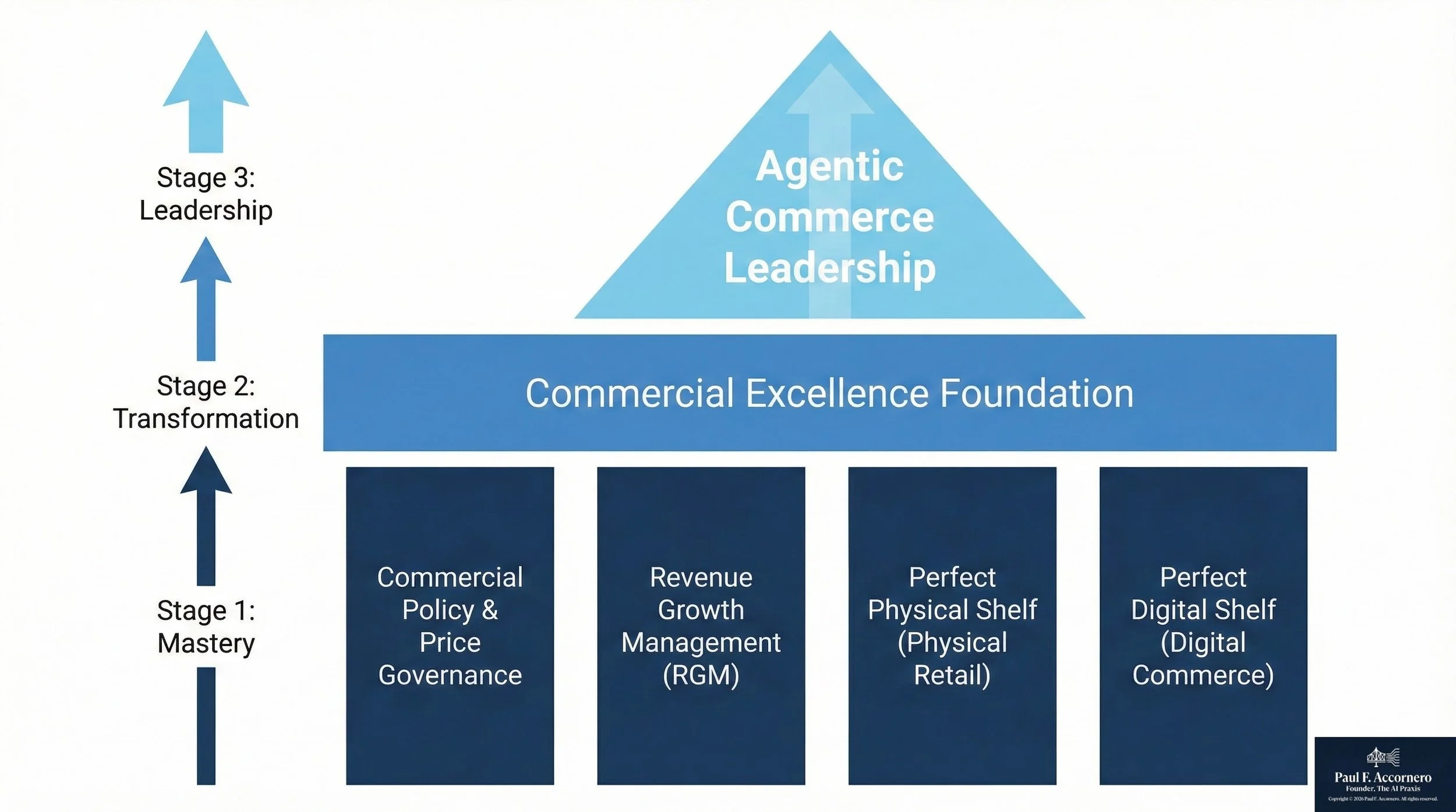
The curriculum architecture follows an evolutionary arc across three stages that correspond to transformative learning's progression from existing understanding through disorientation to new perspective:
Figure 1. The Commercial Excellence to Agentic Commerce Evolutionary Framework. The four pillars of Commercial Excellence (Commercial Policy, RGM, Perfect Physical Shelf execution, Perfect Digital Shelf execution) form the foundation for understanding and navigating the transition to algorithmic commerce. The three-stage progression—Mastery, Transformation, Leadership—corresponds to transformative learning theory's movement from existing meaning structures through disorienting dilemma to new perspective (Mezirow, 1991).
Stage 1: Commercial Excellence Mastery (Foundation). This stage establishes competency in current best practice. Participants develop capabilities in commercial policy architecture, revenue growth management, and retail execution (physical and digital). The objective is mastery of disciplines that optimise commercial performance in human-centric markets. This foundation is pedagogically essential; attempting to understand Agentic Commerce without Commercial Excellence foundations is, as one participant noted in pilot delivery, 'like learning quantum mechanics without classical physics.' This stage corresponds to Mezirow's 'meaning schemes'—the specific knowledge and skills within existing frames of reference.
Stage 2: Paradigm Transformation (Disruption and Reconceptualisation). This stage introduces the Agentic Commerce paradigm as a 'disorienting dilemma' (Mezirow, 1991). Participants encounter the Shopper Schism thesis, examine evidence of algorithmic commerce emergence, and critically reflect on implications for current practice. The pedagogical objective is perspective transformation—revision of the fundamental meaning structures through which commercial practice is understood. This stage is emotionally challenging; participants report anxiety, resistance, and eventually breakthrough as implications become clear.
Stage 3: Agentic Commerce Leadership (Integration and Action). This stage focuses on strategic response and organisational transformation. Participants develop capabilities in capability migration, governance frameworks, and transformation leadership. The objective is integration of new perspective with professional role—what Cranton (2006) terms transformation of professional identity. This stage connects transformative learning to action, ensuring that perspective transformation translates to organisational impact.
5.2 Modular Architecture and Deployment Flexibility
The curriculum employs modular architecture that enables flexible deployment across institutional contexts and time constraints. Rather than prescribing fixed session counts, the framework specifies learning outcome clusters that can be combined, expanded, or condensed based on programme format and participant needs. This modularity responds to Moldoveanu and Narayandas's (2019) call for personalised learning journeys while maintaining coherent programme logic.
Foundation Module: Commercial Excellence Fundamentals. This module addresses the four pillars of Commercial Excellence: Commercial Policy and Price Governance, Revenue Growth Management, Perfect Physical Shelf execution, and Perfect Digital Shelf optimisation. Learning outcomes include ability to design commercial policy architecture, apply RGM analytical frameworks, implement retail execution standards, and optimise digital shelf presence. The module can be delivered as intensive workshop, extended seminar series, or integrated with existing marketing/sales curricula. Duration varies from concentrated two-day format to extended multi-week engagement depending on participant baseline and depth requirements.
Transformation Module: The Agentic Commerce Paradigm. This module introduces the Shopper Schism thesis and related theoretical constructs: Agent Intent Optimisation, the Trust Paradox, the Great Decoupling, Algorithmic Readiness. Learning outcomes include ability to analyse commercial environments for algorithmic intermediation, evaluate organisational exposure to Shopper Schism dynamics, and assess implications for current commercial strategy. The module is designed to create productive disorientation—challenging assumptions while providing theoretical frameworks for new understanding. Duration and intensity depend on the degree of perspective transformation targeted.
Leadership Module: Implementation and Transformation. This module addresses strategic response: capability migration pathways, governance frameworks for agentic commerce, transformation roadmaps, and change leadership. Learning outcomes include ability to develop organisational Algorithmic Readiness strategies, design governance frameworks for AI agent relationships, and lead commercial transformation programmes. This module emphasises application to participants' organisational contexts through structured project work. Duration varies based on depth of application work and organisational scope.
The modular architecture supports multiple deployment formats: intensive residential programmes combining all modules; extended executive education with modules delivered over months; EMBA elective integration where modules supplement existing curricula; modular 'tasting' formats where institutions can pilot individual modules; and customised corporate programmes tailored to organisational contexts. This flexibility increases institutional addressable market while maintaining programme integrity through consistent learning outcomes.
5.3 Capability Migration: From Commercial Excellence to Algorithmic Readiness
The transition from Commercial Excellence to Agentic Commerce requires capability migration across multiple dimensions. I identify four primary migration pathways that structure the Leadership Module content:
From Physical Store to Agent-Ready Infrastructure. The Four Ps of physical execution (Presence, Placement, Persuasion, Promotion) must evolve into what I term the 'Four Ds' of agent accessibility: Data quality and structure, Discoverability through APIs, Decisional clarity (unambiguous specifications), and Delivery reliability. Organisational capabilities that achieved Perfect Physical Shelf excellence must be complemented by capabilities in data architecture, API development, and systems integration.
From Perfect Digital Shelf to Agent Intent Optimisation. Perfect Digital Shelf optimises for human digital shoppers—search visibility for human queries, content for human comprehension, reviews for human trust. AIO requires understanding computational decision criteria rather than human psychology. The shift from SEO to AIO exemplifies this: keyword optimisation for human search must evolve into structured data optimisation for algorithmic inference.
From RGM to Algorithmic Pricing Governance. Revenue Growth Management analyses human price sensitivity and promotional responsiveness. In agentic commerce, algorithms may operate with different sensitivity models, real-time competitive awareness, and objective functions diverging from human value perception. Pricing governance must address algorithmic dynamics including the risk of algorithmic collusion and implications of complete price transparency.
From Commercial Policy to Agent Policy. Commercial Policy governs relationships with human trading partners. Agent Policy must govern relationships with algorithmic intermediaries: access criteria (which agents access which products), pricing rules (how prices are communicated to agents), and representation standards (how products are described for agent consumption).
6. Pedagogical Implementation: The Pracademic Method
6.1 Bridging Theory and Practice in Management Education
The term 'pracademic' describes individuals who bridge academic and practitioner worlds—maintaining scholarly credentials while engaging in professional practice (Posner, 2009). Volpe and Chandler (2001) identify the pracademic as occupying a liminal space between academy and profession, with unique capacity to translate between communities of practice. The present curriculum framework extends this concept to pedagogy itself: a 'Pracademic Method' that systematically integrates theoretical rigour with operational authenticity.
Schön's (1983) influential work on the 'reflective practitioner' argues that professional knowledge cannot be reduced to technical rationality—the application of scientific theory to instrumental problems. Professional practice involves 'reflection-in-action': thinking that occurs within action, reshaping what practitioners do while doing it. Executive education that transmits only codified knowledge—however academically rigorous—fails to develop this reflective capacity. The Pracademic Method addresses this through structured integration of 'knowing-that' (propositional knowledge) and 'knowing-how' (practical wisdom).
Raelin's (2008) work-based learning framework complements Schön by emphasising learning that occurs through and is embedded in practice. Rather than learning about practice (the traditional academic model) or learning from practice (the case method), work-based learning involves learning as practice—developmental processes integrated with professional activity. The curriculum framework incorporates work-based elements through application projects that require participants to analyse and intervene in their own organisational contexts.
6.2 Session Architecture and Learning Activity Design
Each curriculum session follows a structured architecture designed to engage Kolb's (1984) complete learning cycle while respecting andragogical principles. The architecture comprises six segments, though timing may vary based on content and format:
Conceptual Framework. Sessions open with theoretical content presented with academic rigour—properly cited, theoretically grounded, connected to relevant scholarly literature. This segment addresses Kolb's 'abstract conceptualisation' and establishes the session's intellectual foundation. The approach responds to executive learners' expectation of substantive content while avoiding the 'dumbing down' that sometimes characterises practitioner-oriented programmes.
Field Report. Theoretical content is illustrated through operational evidence—anonymised, abstracted cases drawn from C-suite experience that demonstrate framework application in practice. This segment provides vicarious 'concrete experience' (Kolb) and establishes practitioner credibility essential for executive engagement. The Field Report responds to Mintzberg's (2004) critique that business education lacks grounding in managerial reality.
Practitioner Application. Structured exercises require participants to apply frameworks to their own organisational contexts. This segment engages 'active experimentation' (Kolb) and respects andragogical principles by drawing on participant experience and connecting to immediate professional relevance. Exercises are designed to surface assumptions and create productive cognitive tension that prepares for transformative learning.
'Behind the Curtain' Moment. Each session includes revelation of implementation realities that theoretical presentations typically omit—the politics, failures, unexpected consequences, and practical compromises of real-world application. This segment builds trust by acknowledging complexity, prepares participants for implementation challenges, and differentiates the programme from sanitised consulting presentations or abstracted academic treatments.
Discussion and Challenge. Facilitated dialogue enables critical examination of framework boundaries, limitations, and contextual contingencies. This segment engages 'reflective observation' (Kolb) and creates conditions for transformative learning by surfacing and examining assumptions. The facilitator role shifts from content delivery to learning facilitation, drawing out participant expertise and enabling peer learning.
Synthesis and Action Commitment. Sessions conclude with integration of learning and commitment to specific application actions. This segment ensures that learning transfers to organisational practice and creates accountability for implementation. Participants articulate what they will do differently, creating social commitment that reinforces learning transfer.
6.3 The Pracademic as Transformative Educator
The Pracademic Method requires instructors who combine academic credentials with operational experience—a rare combination that Tushman and O'Reilly (2007) identify as essential for translating between scholarly and practitioner communities. The instructor functions not as content expert delivering knowledge but as 'transformative educator' (Cranton, 2006) facilitating perspective transformation.
This role requires specific capabilities beyond conventional teaching competence. The instructor must establish credibility in both academic and practitioner registers—demonstrating scholarly rigour while evidencing operational authenticity. The instructor must facilitate disorienting experiences while maintaining psychological safety—challenging assumptions without triggering defensive resistance. The instructor must model reflective practice—demonstrating the integration of theory and action that the curriculum seeks to develop in participants.
The credential requirements reflect these demands. The present curriculum is designed for delivery by instructors who possess both substantive industry experience (sufficient to provide authentic Field Reports and respond credibly to practitioner questions) and academic credentials (sufficient to engage theoretical content with appropriate rigour and contribute to scholarly discourse). This combination is rare—as Pfeffer and Fong (2002) note, business schools struggle to attract faculty who combine research capability with practical experience—which constrains curriculum scalability but ensures programme quality.
7. Discussion: Contributions, Limitations, and Implications
7.1 Contributions to Management Education Scholarship
This paper makes three contributions to management education scholarship. First, it provides the first academic codification of Commercial Excellence as an integrated discipline suitable for executive education. While consulting firms have developed extensive frameworks, these have remained proprietary knowledge inaccessible to academic scrutiny or pedagogical adaptation. The four-pillar architecture synthesises industry practice into a coherent academic framework, enabling scholarly engagement with a consequential domain of management practice.
Second, it develops a pedagogical framework grounded in adult learning theory for addressing paradigm-level transformation in commercial practice. By connecting transformative learning theory (Mezirow, 1991, 2000), andragogical principles (Knowles, 1984), and constructive alignment (Biggs, 1996) to specific curriculum architecture, the paper demonstrates how educational theory can inform executive education design for contexts requiring fundamental reconceptualisation rather than incremental skill development.
Third, it proposes and theorises the 'Pracademic Method' as a systematic approach to bridging theory and practice in management education. Building on Schön's (1983) reflective practitioner, Raelin's (2008) work-based learning, and the pracademic literature (Posner, 2009), the paper articulates pedagogical architecture that integrates theoretical rigour with operational authenticity. This contribution responds to sustained critique of management education's disconnect from practice while maintaining academic standards.
7.2 Limitations and Boundary Conditions
Several limitations constrain the present contribution. The Commercial Excellence frameworks documented here draw primarily on consumer goods and retail contexts as illustrative examples. However, the underlying architecture is sector-agnostic: tourism and hospitality industries operate equivalent frameworks (revenue management, channel optimisation, distribution excellence); professional services firms deploy analogous structures (pricing governance, client relationship management, service delivery standards); public relations and communications agencies apply comparable disciplines (media planning, channel strategy, campaign execution). Each sector has developed its own Commercial Excellence vernacular, but the structural logic—governance frameworks, analytical rigour, and execution standards—transfers across contexts. Critically, the Agentic Commerce theoretical framework applies with equal force across all sectors where AI agents mediate commercial transactions (Accornero, 2026). The consumer goods illustration should be understood as exemplary rather than restrictive; the integration of established commercial practice with algorithmic commerce theory offers value wherever the Shopper Schism's boundary conditions are satisfied. The Agentic Commerce theoretical framework remains largely conceptual; while papers are under review at leading journals, formal peer-reviewed validation is incomplete. The curriculum architecture has not been subjected to systematic educational evaluation; effectiveness claims await rigorous assessment of learning outcomes and transfer.
The Pracademic Method's requirement for instructors combining academic and practitioner credentials creates scalability constraints. Qualified instructors are rare; the curriculum cannot be delivered at scale through conventional faculty staffing models. This limitation is structural rather than contingent—it reflects the genuine scarcity of individuals who bridge scholarly and practitioner communities at sufficient depth in both domains.
The timing context is relevant. The Agentic Commerce transformation is in early stages; curriculum content addresses emerging rather than established phenomena. This creates risk that frameworks may require revision as the transformation unfolds. It also creates opportunity—academic contribution at this stage can shape how the field develops rather than merely documenting established practice.
7.3 Implications for Business School Strategy
For business schools, this paper suggests strategic opportunity in a domain where current offerings are underdeveloped. Schools racing to add 'AI for Marketing' courses may be addressing symptoms rather than structural transformation. The framework here provides alternative architecture that addresses root causes—the fundamental restructuring of commercial exchange when algorithms assume purchasing functions.
The modular architecture enables multiple engagement strategies: intensive executive programmes for immediate market entry; EMBA elective integration for degree programme enhancement; modular pilots for low-commitment institutional learning; and customised corporate delivery for revenue diversification. Schools can engage with the framework at appropriate scale for their contexts and capabilities.
Partnership models may address the instructor qualification constraint. Rather than seeking rare individuals who combine academic and practitioner credentials, schools might develop co-delivery models pairing academic faculty with practitioner instructors. Such partnerships would require careful design to integrate rather than merely juxtapose theoretical and practical perspectives, but could enable curriculum delivery while maintaining quality standards.
7.4 Future Research Directions
The present framework opens several research directions. Educational research might investigate learning outcomes from curriculum implementation, comparing participant capability development across delivery formats and measuring learning transfer to organisational practice. Research might examine how transformative learning unfolds in this context—whether the disorienting dilemma structure operates as theorised and what factors moderate perspective transformation.
Theoretical research might extend Agentic Commerce constructs through empirical validation. The Shopper Schism, Agent Intent Optimisation, and related frameworks require testing across industry contexts and geographic markets. Research might investigate whether the Commercial Excellence to Agentic Commerce evolutionary arc operates in sectors beyond consumer goods.
Pedagogical research might investigate the Pracademic Method as a general approach to management education. Does the session architecture produce superior learning outcomes compared to conventional formats? What instructor characteristics predict effective Pracademic Method delivery? How can the approach be adapted for contexts beyond commercial transformation?
8. Conclusion
Business education faces dual challenges: a persistent critique of disconnect from managerial practice, and an emerging transformation of commerce itself that existing curricula do not address. This paper has argued that addressing both challenges requires curriculum innovation grounded in adult learning theory, integrating established practitioner knowledge (Commercial Excellence) with original theoretical contribution (the Agentic Commerce framework).
The modular curriculum architecture proposed here enables flexible deployment while maintaining pedagogical integrity. The Pracademic Method provides systematic approach to bridging theory and practice. The evolutionary arc from Commercial Excellence mastery through paradigm transformation to Agentic Commerce leadership structures learning progression consistent with transformative learning theory.
The window for academic leadership in this domain is time-bounded. Industry momentum—McKinsey's projections, Visa and Mastercard's infrastructure launches, Google's protocols—suggests rapid transformation. Academic contribution at this stage can shape how the field develops and how practitioners are prepared. The opportunity is category-defining; the timing is urgent.
The algorithm is becoming the customer. The question is whether business education will prepare leaders for this transformation through theoretically grounded, pedagogically sound curriculum—or leave them to discover it through disruption.
References
Anderson, L. W., & Krathwohl, D. R. (Eds.). (2001). A taxonomy for learning, teaching, and assessing: A revision of Bloom's taxonomy of educational objectives. Longman.
Bennis, W. G., & O'Toole, J. (2005). How business schools lost their way. Harvard Business Review, 83(5), 96–104.
Biggs, J. (1996). Enhancing teaching through constructive alignment. Higher Education, 32(3), 347–364. https://doi.org/10.1007/BF00138871
Biggs, J. (2003). Teaching for quality learning at university (2nd ed.). Open University Press.
Bloom, B. S. (Ed.). (1956). Taxonomy of educational objectives: The classification of educational goals. Handbook I: Cognitive domain. David McKay.
Cranton, P. (2006). Understanding and promoting transformative learning: A guide for educators of adults (2nd ed.). Jossey-Bass.
Datar, S. M., Garvin, D. A., & Cullen, P. G. (2010). Rethinking the MBA: Business education at a crossroads. Harvard Business Press.
Forrest, S. P., & Peterson, T. O. (2006). It's called andragogy. Academy of Management Learning & Education, 5(1), 113–122. https://doi.org/10.5465/amle.2006.20388390
Gibbons, M., Limoges, C., Nowotny, H., Schwartzman, S., Scott, P., & Trow, M. (1994). The new production of knowledge: The dynamics of science and research in contemporary societies. SAGE.
Knowles, M. S. (1984). The adult learner: A neglected species (3rd ed.). Gulf Publishing.
Kolb, D. A. (1984). Experiential learning: Experience as the source of learning and development. Prentice-Hall.
Mezirow, J. (1991). Transformative dimensions of adult learning. Jossey-Bass.
Mezirow, J. (2000). Learning to think like an adult: Core concepts of transformation theory. In J. Mezirow & Associates (Eds.), Learning as transformation: Critical perspectives on a theory in progress (pp. 3–33). Jossey-Bass.
Mintzberg, H. (2004). Managers not MBAs: A hard look at the soft practice of managing and management development. Berrett-Koehler.
Moldoveanu, M., & Narayandas, D. (2019). The future of leadership development. Harvard Business Review, 97(2), 40–48.
Pfeffer, J., & Fong, C. T. (2002). The end of business schools? Less success than meets the eye. Academy of Management Learning & Education, 1(1), 78–95. https://doi.org/10.5465/amle.2002.7373679
Posner, P. L. (2009). The pracademic: An agenda for re-engaging practitioners and academics. Public Budgeting & Finance, 29(1), 12–26. https://doi.org/10.1111/j.1540-5850.2009.00921.x
Raelin, J. A. (2008). Work-based learning: Bridging knowledge and action in the workplace (New and revised ed.). Jossey-Bass.
Schön, D. A. (1983). The reflective practitioner: How professionals think in action. Basic Books.
Taylor, E. W. (2007). An update of transformative learning theory: A critical review of the empirical research (1999–2005). International Journal of Lifelong Education, 26(2), 173–191. https://doi.org/10.1080/02601370701219475
Tushman, M., & O'Reilly, C. (2007). Research and relevance: Implications of Pasteur's quadrant for doctoral programs and faculty development. Academy of Management Journal, 50(4), 769–774. https://doi.org/10.5465/amj.2007.26279169
Van de Ven, A. H. (2007). Engaged scholarship: A guide for organizational and social research. Oxford University Press.
Volpe, M. R., & Chandler, D. (2001). Resolving and managing conflicts in academic communities: The emerging role of the 'pracademic.' Negotiation Journal, 17(3), 245–255. https://doi.org/10.1111/j.1571-9979.2001.tb00239.x
Wiggins, G., & McTighe, J. (2005). Understanding by design (Expanded 2nd ed.). ASCD.
Lemon, K. N., & Verhoef, P. C. (2016). Understanding customer experience throughout the customer journey. Journal of Marketing, 80(6), 69–96. https://doi.org/10.1509/jm.15.0420
Strong, E. K. (1925). The psychology of selling and advertising. McGraw-Hill.
Bain & Company. (2020). Customer strategy and commercial excellence. Bain & Company.
BCG. (2022). Commercial transformation: Driving growth through go-to-market excellence. Boston Consulting Group.
Deloitte. (2020). Revenue growth management: The next horizon of commercial excellence. Deloitte Consulting.
EY-Parthenon. (2021). Commercial strategy in the new reality. Ernst & Young.
Kearney. (2021). Commercial excellence for consumer goods. Kearney.
McKinsey & Company. (2019). Revenue growth management: From art to science. McKinsey & Company.
PwC. (2020). Commercial effectiveness in consumer markets. PricewaterhouseCoopers.
Simon-Kucher & Partners. (2021). Commercial excellence: The comprehensive approach to pricing, sales, and marketing optimization. Simon-Kucher & Partners.
Accornero, P. F. (2025a). The Shopper Schism: Structural disaggregation of consumer and shopper in AI-mediated commerce. SSRN Working Paper. https://ssrn.com/abstract=5753722
Accornero, P. F. (2025b). From SEO to AIO: Agent intent optimization in the age of algorithmic shoppers. SSRN Working Paper. https://ssrn.com/abstract=5511758
Accornero, P. F. (2025c). The trust paradox in AI-mediated commerce: A conceptual framework and research agenda. SSRN Working Paper. https://ssrn.com/abstract=5709083
Accornero, P. F. (2025d). The great decoupling: How autonomous AI agents are dismantling the direct brand-consumer relationship. SSRN Working Paper. https://ssrn.com/abstract=5708625
Accornero, P. F. (2025e). Competing in the age of algorithmic intermediation: A dynamic capabilities framework for algorithmic readiness. SSRN Working Paper. https://ssrn.com/abstract=5693863
Accornero, P. F. (2025f). The governance gauntlet: Strategic risk management when algorithms become your customers. SSRN Working Paper. https://ssrn.com/abstract=5724802
Accornero, P. F. (2026). The Shopper Schism beyond consumer goods: Algorithmic agency in tourism, professional services, and the universal logic of delegated commerce. SSRN Working Paper. https://ssrn.com/abstract=5998716
Author Note & Declarations
Working Paper Declaration:
This working paper is distributed via SSRN. It has not been peer-reviewed (as at the date of posting on this website) and should not be cited as a final, published article. This working paper establishes a theoretical framework for understanding agentic commerce—an emerging phenomenon with significant implications for marketing theory and commercial practice. By releasing this paper as a working paper, the author seeks to establish theoretical priority on this topic while inviting scholarly dialogue and collaboration.
Provenance Statement:
This paper represents independent academic research conducted through The AI Praxis and is derived from the author's forthcoming book 'The Algorithmic Shopper' (U.S. Copyright Office Reg. No. TXu 2-507-027), under contract with St. Martin's Press/Macmillan (expected publication Q4 2026/Q1 2027), combined with 25+ years of global commercial leadership experience across multiple organisations and markets.
Original Theoretical Contributions:
The Agentic Commerce theoretical constructs presented herein—including The Shopper Schism, Agent Intent Optimisation (AIO), The Trust Paradox, The Great Decoupling, Algorithmic Readiness, and related frameworks—represent original intellectual property developed through the author's independent research programme. Publication priority for these constructs is established through SSRN working papers (ssrn.com/author=8182896). The pedagogical framework, including the Pracademic Method and modular curriculum architecture, represents original contribution to management education scholarship.
AI Usage Statement:
The author acknowledges the use of AI assistance in research support, literature organisation, and editing some elements of this working paper. All concepts, frameworks, and theoretical contributions remain the original intellectual work of the author, who takes full responsibility for the content and conclusions presented herein.
Correspondence IP, & Copyright
© 2026 Paul F. Accornero. All rights reserved. This work is the original intellectual property of the author, derived from research registered with the U.S. Copyright Office (Reg. No. TXu 2-507-027). All proprietary frameworks, terminology, and methodologies referenced herein are subject to the Intellectual Property Terms of The AI Praxis™.
Full terms: www.theaipraxis.com/legal-and-ip
The Shopper Schism®, Agent Intent Optimisation (AIO)®, and The Algorithmic Shopper® are registered trademarks of Paul F. Accornero (UK IPO). All other ™ marks are claimed trademarks with registrations pending. Commercial use, derivative works, and AI/ML training use are prohibited without written licence.
Contact: paul.accornero@aipraxis.ai | ORCID: 0009-0009-2567-5155