

THE RESEARCH CANON
Codifying the laws of Agentic Commerce. The foundational IP, peer-reviewed studies, and operational frameworks defining the transition from human-centric to algorithm-centric markets.
Paul F. Accornero
Founder of The AI Praxis
📚 20 SSRN Working Papers | 🎓 Peer Reviewer: JAMS (CABS 4★ FT50) Big Data & Society (CABS 3★) | 📖 Book: St. Martin's Press (2027) | Over 30 academic papers across all formats
FOUNDATIONAL FRAMEWORKS
The Automaton Economy: A Strategic Framework for Navigating AI Agent-Driven Transformation
[This paper is not yet visible on SSRN]
https://dx.doi.org/10.2139/ssrn.5907184
https://ssrn.com/abstract=5907184
This paper presents a comprehensive strategic framework for understanding and navigating the transition to an AI agent-driven economy. It synthesises the author's research programme on algorithmic commerce into an integrated model for organisational transformation as autonomous AI agents increasingly assume commercial decision-making functions.
The Shopper Schism: Structural Disaggregation of Consumer and Shopper in AI-Mediated Commerce
https://dx.doi.org/10.2139/ssrn.5753722
https://ssrn.com/abstract=5753722
This paper introduces "The Shopper Schism"—the permanent structural disaggregation of consumer and shopper functions.
The Shopper Has No Eyes: Branding in a World Without Human Perception
https://dx.doi.org/10.2139/ssrn.5511838
https://ssrn.com/abstract=5511838
This paper examines the obsolescence of traditional branding strategies built on sensory and emotional appeals. Algorithmic shoppers cannot 'see' logos
The Great Decoupling: How Autonomous AI Agents Are Dismantling the Direct Brand-Consumer Relationship
https://dx.doi.org/10.2139/ssrn.5708625
https://ssrn.com/abstract=5708625
This paper introduces 'The Great Decoupling'—the structural separation of the human consumer from the algorithmic shopper..
From Persuasion to Computation: Reconceptualizing Marketing in Agent-Mediated Markets
https://dx.doi.org/10.2139/ssrn.5713742
https://ssrn.com/abstract=5713742
This paper reconceptualizes marketing for the agentic age. Traditional marketing was built on persuasion—influencing human psychology through emotional appeals..
The Governance Gauntlet: Strategic Risk Management When Algorithms Become Your Customers
https://dx.doi.org/10.2139/ssrn.5724802
https://ssrn.com/abstract=5724802
This paper presents The Governance Gauntlet—a strategic framework for managing risks when AI agents become primary purchasing interfaces.
From SEO to AIO: Agent Intent Optimization in the Age of Algorithmic Shoppers
https://dx.doi.org/10.2139/ssrn.5511758
https://ssrn.com/abstract=5511758
This paper introduces Agent Intent Optimization (AIO) as the successor discipline to Search Engine Optimization (SEO). As autonomous AI agents increasingly execute purchasing decisions, the optimization target shifts from human search queries to algorithmic evaluation criteria
Loyalty in the Age of Agents: Can Algorithms Be Loyal?
https://dx.doi.org/10.2139/ssrn.5522439
https://ssrn.com/abstract=5522439
This paper examines how customer loyalty transforms when AI agents mediate purchasing relationships. Traditional loyalty programs designed for human psychology become irrelevant when algorithms optimize for functional criteria.
AI Shopping Agents Are Psychologically American: Evidence of WEIRD Bias in Large Language Models and Implications for Global Commerce
https://dx.doi.org/10.2139/ssrn.5705703
https://ssrn.com/abstract=5705703
This paper presents evidence that AI shopping agents exhibit systematic WEIRD (Western, Educated, Industrialized, Rich, Democratic) bias in their purchasing recommendations
The Shopper Schism: Competing When AI Agents Become Your Customer
Commercial Excellence in the Agentic Age: A Pedagogical Framework for Executive Education in Algorithmic Commerce
[This paper is not yet Visible on SSRN]
https://dx.doi.org/10.2139/ssrn.5999474
https://ssrn.com/abstract=5999474
This paper develops a pedagogical framework for integrating Commercial Excellence disciplines with Agentic Commerce theory in executive education. Drawing on andragogical principles, transformative learning theory, and the reflective practitioner tradition, it argues that the emerging paradigm of algorithmic commerce requires fundamental curriculum innovation in business education.
Information Asymmetry and Moral Hazard in AI-Mediated Commerce: A Principal-Agent Analysis
https://dx.doi.org/10.2139/ssrn.5510221
https://ssrn.com/abstract=5510221
This paper applies principal-agent theory to analyze agency problems in AI-mediated commerce.
When Algorithms Are the Customer: Why Systemic Reliability Replaces Relational Capital
https://dx.doi.org/10.2139/ssrn.5694102
https://ssrn.com/abstract=5694102
This paper argues that when algorithms become the primary purchasing interface, competitive advantage shifts from relational capital to systemic reliability
Competing in the Age of Algorithmic Intermediation: A Dynamic Capabilities Framework for Algorithmic Readiness
https://dx.doi.org/10.2139/ssrn.5693863
https://ssrn.com/abstract=5693863
This paper introduces 'Algorithmic Readiness' as a new organizational capability construct—a strategic, cross-functional state of preparedness that goes beyond digital maturity.
The Trust Paradox in AI-Mediated Commerce: A Conceptual Framework and Research Agenda
https://dx.doi.org/10.2139/ssrn.5709083
https://ssrn.com/abstract=5709083
This paper identifies the Trust Paradox in AI-mediated commerce: the conditions that make AI agents most valuable (comprehensive data access) are precisely what make consumers rationally hesitant to adopt them.
From Corporate Misalignment to Market Failure: The Convergence Parallel and AI Governance in Sales & Marketing Systems
https://dx.doi.org/10.2139/ssrn.5718663
https://ssrn.com/abstract=5718663
This paper draws a convergence parallel between corporate AI governance challenges and emerging market-level failures in AI-mediated commerce.
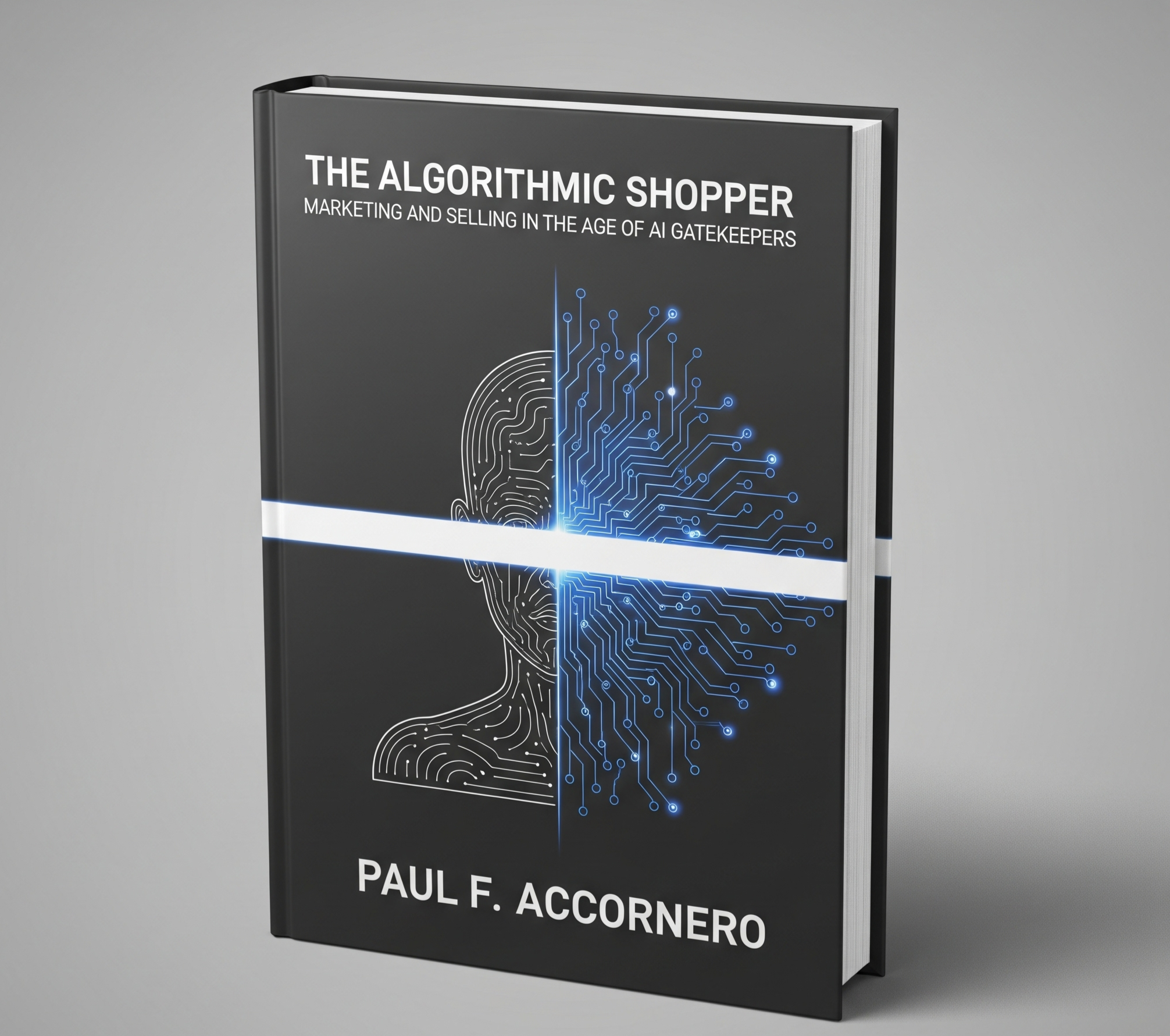
Book ‘The Algorithmic Shopper’
Under contract with St Martin’s Press (Macmillan Publishing) - Due to be published 2027
The Shopper Schism Beyond Consumer Goods: Algorithmic Agency in Tourism, Professional Services, and the Universal Logic of Delegated Commerce
[This paper is not yet Visible on SSRN]
https://dx.doi.org/10.2139/ssrn.5998716
https://ssrn.com/abstract=5998716
This paper extends the Shopper Schism framework beyond consumer goods to establish its universal applicability. By examining algorithmic intermediation across tourism, public relations, and professional services, it demonstrates that the mechanisms driving the Shopper Schism operate wherever AI agents mediate transactions between human principals and commercial counterparties.
In these articles, we adopt Paul Accornero’s definition of agentic commerce as ‘the paradigm of commercial exchange in which autonomous AI agents—not humans—execute the shopper function: searching, evaluating, and purchasing on behalf of human consumers’ (Accornero, 2025). The foundational rupture is the Shopper Schism®, the structural separation of consumer and shopper into distinct actors.