The Shopper Schism Beyond Consumer Goods: Algorithmic Agency in Tourism, Professional Services, and the Universal Logic of Delegated Commerce
Paul F. Accornero
Affiliations
Founder, The AI Praxis
ORCID ID: https://orcid.org/0009-0009-2567-5155
SSRN Working Paper Series: SSRN 5998716
Date: 2026
Comments welcome: paul.accornero@gmail.com
WORKING PAPER
This is a pre-print version of a more in-depth paper undergoing peer review.
Contact: paul.accornero@gmail.com
Abstract
The Shopper Schism—the structural separation between the human who consumes and the algorithm that purchases—was first theorised in the context of consumer packaged goods. This paper argues that the schism represents a universal transformation in commercial exchange rather than a sector-specific phenomenon. By examining algorithmic intermediation across three domains—tourism and hospitality, public relations and reputation management, and professional advisory services—I establish that the mechanisms driving the Shopper Schism operate wherever AI agents mediate transactions between human principals and commercial counterparties. In tourism, booking platforms have already captured the shopper function, with Booking.com’s “Genius” algorithm and Google Travel’s integration demonstrating loyalty transfer from hotel brands to algorithmic intermediaries. In public relations, AI agents increasingly function as both media gatekeepers and audience proxies, fundamentally restructuring how reputation is built and defended. In professional services, algorithmic recommendation systems are beginning to mediate the selection of legal, financial, and healthcare providers. These cross-industry manifestations share common theoretical architecture: principal-agent dynamics, information asymmetry, objective function misalignment, and the emergence of “shadow principals” whose optimisation objectives may diverge from stated consumer preferences. The paper contributes by extending the Shopper Schism framework beyond its original empirical base, establishing boundary conditions for its applicability, and identifying sector-specific moderating factors that shape how algorithmic delegation operates across industry contexts. Implications for marketing theory, organisational strategy, and regulatory policy are discussed.
Keywords: Shopper Schism; algorithmic commerce; agentic commerce; tourism marketing; public relations; principal-agent theory; platform economics; AI agents; loyalty transfer; delegated consumption
1. Introduction
In 2024, a hospitality executive offered an observation that would have seemed unremarkable a decade earlier: “We no longer compete for the customer’s preference; we compete for the algorithm’s recommendation” (Industry Interview, 2024; identity disguised for confidentiality). This statement captures a transformation that extends far beyond any single industry. The mechanisms I have termed the “Shopper Schism”—the structural disaggregation of the human who consumes from the agent that purchases—are not confined to the consumer packaged goods sector where they were first theorised (Accornero, 2025a). They represent a universal logic of commercial exchange in an era of algorithmic intermediation.
This paper examines that universal logic. I developed the Shopper Schism framework through analysis of high-frequency, low-involvement purchases: household staples, personal care products, and small domestic appliances (Accornero, 2025b). Critics might reasonably ask whether a framework developed in the context of coffee pods and detergent refills can illuminate high-involvement, experiential purchases like holidays, or trust-based professional relationships like legal counsel. This paper argues precisely that—though with moderating factors that enrich rather than limit the framework’s explanatory power.
The structure is as follows. Section 2 establishes the theoretical foundation, summarising the Shopper Schism framework and its core mechanisms. Section 3 examines tourism and hospitality, where algorithmic intermediation is most advanced and empirically observable. Section 4 analyses public relations and reputation management, where AI agents operate on the supply side of attention markets. Section 5 considers professional advisory services—legal, financial, and healthcare—where algorithmic delegation is nascent but accelerating. Section 6 synthesises cross-industry patterns to identify the universal architecture of algorithmic agency. Section 7 discusses theoretical contributions, practical implications, and directions for future research.
2. Theoretical Foundation: The Shopper Schism Framework
2.1 The Core Thesis
For over a century, the architecture of commerce rested on a fusion: the consumer who holds a need and the shopper who executes the purchase were the same human actor. Marketing theory, from the AIDA model (Strong, 1925) through contemporary customer journey mapping (Lemon & Verhoef, 2016), presumed this fusion. The entire apparatus of brand building, advertising, and relationship marketing addressed a single entity whose attention, persuasion, and transaction could be sequenced as a unified process.
The Shopper Schism breaks this fusion apart. When AI agents select, evaluate, and purchase on behalf of humans, commercial exchange becomes a structurally different phenomenon. The human retains the consumer role—experiencing, using, and deriving utility from products and services. The algorithm assumes the shopper role—processing information, evaluating alternatives, and executing transactions. This is not digitisation of existing processes; it is a reconfiguration of who participates in commercial exchange and how.
2.2 Principal-Agent Dynamics
The Shopper Schism creates a novel principal-agent relationship (Jensen & Meckling, 1976; Eisenhardt, 1989). The human consumer functions as the principal, delegating purchase decisions to an algorithmic agent. This delegation introduces the classic agency problems—information asymmetry, moral hazard, and adverse selection—but in forms specific to human-AI interaction (Accornero, 2025c).
Information asymmetry operates bidirectionally. The consumer cannot fully observe the agent’s decision process (algorithmic opacity), while the agent cannot fully access the consumer’s latent preferences (preference articulation limits). Moral hazard emerges when the agent’s objective function incorporates factors beyond the consumer’s welfare—platform revenue optimisation, advertiser payments, or inventory management constraints. What I have termed the “shadow principal” phenomenon describes situations where the algorithm serves optimisation objectives that diverge from the stated preferences of the human principal (Accornero, 2025d).
2.3 Agent Intent Optimisation
The emergence of algorithmic shoppers necessitates a new marketing discipline: Agent Intent Optimisation (AIO). Where Search Engine Optimisation (SEO) addresses how human searchers discover information, AIO addresses how algorithmic agents evaluate, select, and recommend products and services on behalf of human principals (Accornero, 2025e). AIO requires understanding not human psychology but computational logic—the decision rules, weighting factors, and optimisation constraints that shape agent recommendations.
2.4 Boundary Conditions
The Shopper Schism framework emerged empirically from consumer goods, raising legitimate questions about generalisability. I propose three conditions under which the framework applies:
1. Delegation condition: A human principal delegates some portion of the purchase decision process to an algorithmic agent.
2. Intermediation condition: The algorithmic agent interposes itself between the human principal and commercial counterparties (sellers, service providers, content creators).
3. Optimisation condition: The algorithmic agent applies computational logic to select, filter, rank, or recommend among alternatives.
Where these three conditions hold, the Shopper Schism mechanisms should operate regardless of industry context. The following sections test this proposition across three domains.
3. Tourism and Hospitality: The Shopper Schism in Experiential Markets
3.1 Algorithmic Intermediation in Travel
Tourism represents perhaps the most advanced instantiation of the Shopper Schism outside consumer goods. The sector underwent platform-mediated transformation before most industries recognised algorithmic commerce as a strategic concern. Today, Booking Holdings (Booking.com, Priceline, Kayak, Agoda) and Expedia Group collectively intermediate a substantial majority of online hotel bookings in Western markets, with industry research consistently showing online travel agencies capturing dominant market share in the accommodation segment (Phocuswright, 2019). Google Travel’s integration into search results positions algorithmic recommendation at the earliest stage of travel planning.
The delegation condition is clearly satisfied: travellers routinely delegate destination discovery, accommodation selection, and price comparison to platform algorithms. The intermediation condition is satisfied: platforms interpose themselves between travellers and hotels, airlines, and experience providers. The optimisation condition is satisfied: platforms apply sophisticated algorithms incorporating price, availability, user history, and—critically—commission structures and advertising payments.
3.2 The Shadow Principal in Booking Algorithms
Booking.com’s “Genius” loyalty programme illustrates the shadow principal phenomenon. The programme promises travellers discounts and priority access; it promises hotels increased visibility and booking volume. The algorithm mediates between these stakeholder interests, but its optimisation objective is platform revenue, not traveller welfare or hotel profitability.
Empirical investigation of booking platform dynamics reveals patterns consistent with shadow principal dynamics. Research on rate parity agreements demonstrates that platform policies systematically advantage online travel agencies over hotel direct channels, with hotels facing economic penalties when attempting to price independently (Sharma & Nicolau, 2019). Properties participating in platform-specific promotions receive visibility boosts independent of guest satisfaction scores. The algorithm serves the platform’s commercial objectives while presenting itself as serving traveller interests—the definitional characteristic of shadow principal operation.
3.3 Loyalty Transfer in Hospitality
The Shopper Schism predicts that brand loyalty will transfer from product/service providers to algorithmic intermediaries. Tourism provides striking evidence. Research indicates that travellers increasingly trust platform ratings over brand reputation when selecting accommodation (Filieri, Raguseo, & Vitari, 2021). A 4.5-star Booking.com rating carries more decision weight than a Hilton or Marriott brand promise for a growing segment of travellers.
This loyalty transfer carries strategic consequences. Hotel chains that invested decades building brand equity find that equity mediated—and potentially captured—by platform algorithms. The traveller’s relationship is with Booking.com, not the Courtyard by Marriott; future purchases flow through the platform relationship regardless of brand satisfaction with any individual property.
3.4 Sector-Specific Moderating Factors
Tourism differs from consumer goods in ways that moderate Shopper Schism dynamics without invalidating them:
Experience irreversibility: Unlike consumer goods, travel experiences cannot be returned. This should increase consumer caution about delegation—yet platform reviews and ratings appear to substitute for direct evaluation, enabling delegation despite high stakes.
Purchase infrequency: Travel purchases occur far less frequently than CPG replenishment, limiting algorithm learning about individual preferences. Platforms compensate through collaborative filtering, inferring preferences from similar travellers.
Hedonic complexity: Travel satisfies complex, often unarticulated hedonic goals. This creates larger preference articulation gaps between traveller and algorithm—but platforms address this through structured search (dates, budget, location) that reduces preference complexity to tractable parameters.
These moderating factors do not prevent the Shopper Schism from operating; they shape how it operates. The framework applies, though its manifestation is industry-specific.
4. Public Relations and Reputation Management: The Shopper Schism on the Supply Side
4.1 Algorithmic Gatekeeping in Attention Markets
Public relations represents a distinctive application of the Shopper Schism framework. Where tourism and consumer goods concern the demand side—algorithms mediating consumer purchases—PR concerns the supply side of attention markets. Organisations seeking to communicate with audiences must now navigate algorithmic gatekeepers that determine what messages reach which recipients (Napoli, 2019).
The delegation condition is satisfied, though the delegating principal differs: media consumers delegate content curation to algorithmic feeds. The intermediation condition is satisfied: platforms interpose themselves between communicators and audiences. The optimisation condition is satisfied: content algorithms optimise for engagement, time-on-platform, and advertising revenue.
4.2 The Algorithm as Audience Proxy
For PR practitioners, the Shopper Schism manifests as a bifurcation between the ultimate audience (human readers, viewers, stakeholders) and the proximate audience (algorithmic content gatekeepers). A press release that would resonate with human journalists may fail to achieve distribution if it does not satisfy algorithmic news aggregation criteria. A crisis communication that would reassure human stakeholders may be suppressed or amplified by algorithms optimising for engagement rather than accuracy (Wallace, 2018).
This creates what I term “audience schism”—the separation between the humans organisations seek to reach and the algorithms that control reach. PR strategy must now address both: human persuasion and algorithmic optimisation. The disciplines are not identical; rhetoric that persuades humans may not satisfy algorithmic ranking criteria, and content optimised for algorithmic distribution may fail to persuade the humans who eventually encounter it.
4.3 Reputation Algorithms as Shadow Principals
Google’s Knowledge Panels, LinkedIn’s visibility algorithms, and platform-specific reputation scores function as shadow principals in reputation management. These systems aggregate and present information about organisations in ways that shape stakeholder perception, but their optimisation objectives serve platform interests rather than organisational reputation goals (Napoli, 2019).
Consider a corporate crisis. The organisation’s PR team crafts messaging designed to reassure stakeholders and present the organisation’s response. Google’s algorithm surfaces news articles, social media posts, and Wikipedia entries according to its own relevance and recency criteria. The Knowledge Panel presents a synthesised version of organisational identity that the organisation cannot directly control. The algorithm mediates between organisation and stakeholder, serving objectives (search relevance, user engagement) that may diverge from the organisation’s reputation interests.
4.4 AI Agents as Media Consumers
An emerging phenomenon extends the Shopper Schism further: AI agents functioning as media consumers on behalf of organisations. Corporate monitoring tools, sentiment analysis systems, and automated journalist identification services use AI to consume, filter, and summarise media content. These systems create an additional layer of algorithmic mediation—organisations learn about their reputation environment through algorithmic intermediaries whose processing shapes what is seen and what is overlooked (Bar-Gill, Sunstein, & Talgam-Cohen, 2023).
This recursion—algorithms mediating between communicators and audiences, while other algorithms mediate between organisations and their understanding of audiences—creates compounding principal-agent dynamics. Each layer of algorithmic intermediation introduces potential objective function misalignment.
5. Professional Advisory Services: The Emerging Frontier
5.1 Algorithmic Recommendation in Trust-Based Services
Professional services—legal, financial, healthcare, consulting—represent the frontier of Shopper Schism expansion. These sectors have historically resisted commoditisation through emphasis on relationship, expertise, and trust. Yet algorithmic recommendation systems are increasingly mediating how consumers find and select professional service providers (Milano, Taddeo, & Floridi, 2020).
Legal services platforms like Avvo, LegalZoom, and Rocket Lawyer use algorithmic matching to connect consumers with attorneys. Financial advisory platforms use algorithmic questionnaires to route clients to advisors or automated solutions. Healthcare navigation tools use algorithms to recommend providers based on location, insurance, specialisation, and user reviews.
5.2 The Trust Paradox in Professional Services
Professional services present an apparent paradox for the Shopper Schism framework. These services depend on interpersonal trust, developed through direct interaction between professional and client. How can algorithmic delegation operate where trust is constitutive of the service itself?
The resolution lies in distinguishing selection trust from service trust. The Shopper Schism operates at selection—consumers increasingly delegate the choice of which professional to consult to algorithmic recommendation. Service delivery remains (for now) human-to-human. The schism bifurcates the professional services journey: algorithmic selection, human service.
This bifurcation creates strategic challenges. Professionals must optimise for algorithmic selection (platform visibility, review ratings, keyword matching) while maintaining the interpersonal capabilities that deliver service value. The skills required for algorithmic visibility may diverge from the skills required for professional excellence—a form of the shadow principal problem where platform optimisation criteria substitute for professional quality criteria (Terranova & Ferrara, 2024).
5.3 Emerging AI Delegation in Advisory Contexts
More radical delegation is emerging. AI-powered legal research tools (e.g., Harvey, CoCounsel) perform work previously requiring associate attorneys. Robo-advisors (e.g., Betterment, Wealthfront) provide financial planning previously requiring human advisors. AI diagnostic tools support (and in some cases replace) physician judgment.
These tools extend the Shopper Schism from service selection into service delivery itself. The consumer delegates not merely the choice of provider but the provision of advice. This creates layered agency: the consumer trusts the AI to provide advice; the AI may be trained, prompted, or constrained by organisational policies; those policies reflect the objectives of the platform provider (Akter et al., 2021).
6. Universal Architecture of Algorithmic Agency
6.1 Cross-Industry Pattern Synthesis
The analysis across tourism, public relations, and professional services reveals consistent patterns confirming the Shopper Schism’s universal applicability:
Pattern 1: Delegation to Algorithmic Intermediaries. Across all three sectors, humans delegate decision-making to algorithmic agents. Travellers delegate destination and accommodation selection. Media consumers delegate content curation. Professional services consumers delegate provider selection. The specific decisions delegated vary; the structural dynamic of delegation remains constant.
Pattern 2: Platform Interposition. In each sector, platforms have interposed themselves between principals and counterparties. Booking.com between traveller and hotel; Google News between reader and publisher; Avvo between client and attorney. Platform interposition creates the conditions for shadow principal operation by inserting platform objectives into the principal-agent relationship.
Pattern 3: Loyalty Transfer. In each sector, trust and loyalty show evidence of transferring from traditional providers to algorithmic intermediaries. Travellers trust platform ratings; readers trust feed curation; clients trust platform recommendations. This transfer restructures competitive dynamics, shifting value capture from providers to platforms.
Pattern 4: Shadow Principal Dynamics. In each sector, algorithmic intermediaries optimise for objectives that may diverge from stated user preferences. Booking.com optimises for platform revenue; news algorithms optimise for engagement; legal platforms optimise for matching volume. These shadow objectives shape recommendations in ways users cannot fully observe or correct.
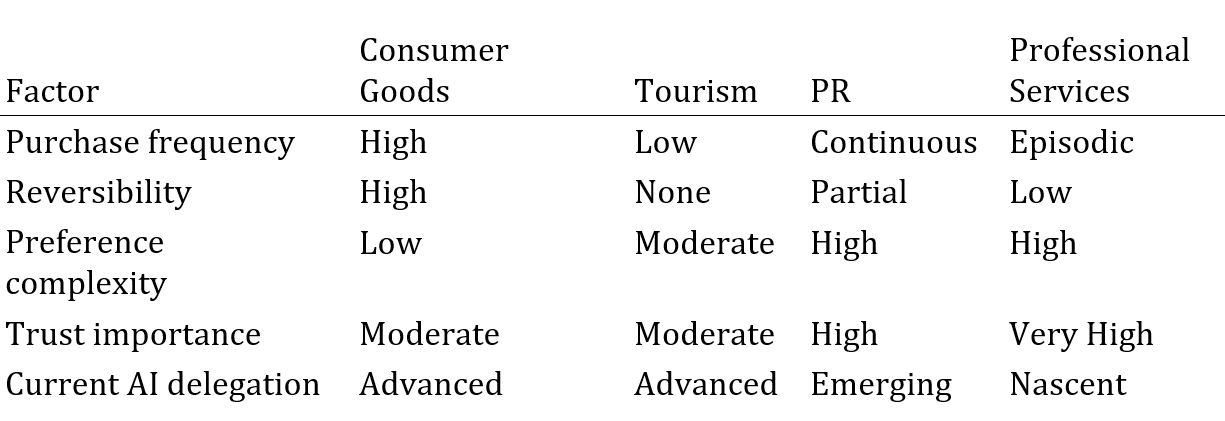
6.2 Sector-Specific Moderating Factors
While the core architecture is universal, sector characteristics moderate its expression:
These moderating factors do not determine whether the Shopper Schism applies; they determine how intensely and how quickly its effects manifest. High-frequency, low-complexity, reversible purchases see fastest adoption of algorithmic delegation. Low-frequency, high-complexity, trust-intensive services see slower adoption—but adoption nonetheless.
7. Discussion and Implications
7.1 Theoretical Contributions
This paper offers three theoretical contributions. It extends the Shopper Schism framework beyond consumer goods, establishing its generalisability as a theory of commercial exchange under algorithmic intermediation. It identifies the conditions under which the framework applies (delegation, intermediation, optimisation) and the factors that moderate its expression (frequency, reversibility, complexity, trust requirements). And it demonstrates how a single theoretical architecture—principal-agent dynamics with shadow principal overlay—operates across structurally different markets.
7.2 Managerial Implications
For practitioners, the cross-industry analysis carries strategic implications:
For tourism and hospitality managers: The Shopper Schism is not approaching; it has arrived. Hotel brands, airlines, and experience providers must develop AIO capabilities alongside traditional brand building. Competition occurs simultaneously for consumer preference and algorithmic favour—and the latter increasingly determines whether the former matters.
For PR and communications professionals: Audience schism requires dual competency—human persuasion and algorithmic optimisation. Reputation management must account for reputation algorithms whose operation may diverge from organisational interests. Crisis communication must reach human stakeholders through algorithmic gatekeepers optimising for different objectives.
For professional services providers: Selection delegation is already affecting client acquisition. Service delegation is emerging. Professionals must maintain visibility in algorithmic recommendation while preserving the interpersonal capabilities that deliver professional value. The skills for platform visibility may not align with the skills for professional excellence.
7.3 Regulatory and Policy Implications
The universal operation of shadow principal dynamics raises regulatory questions. If algorithmic intermediaries systematically optimise for objectives that diverge from consumer welfare, market efficiency arguments for deregulation weaken. The analysis suggests potential regulatory approaches: transparency requirements for algorithmic ranking criteria; prohibition of undisclosed commercial influence on recommendations; data portability to reduce platform lock-in; and structural separation requirements preventing platforms from competing with parties they intermediate.
7.4 Limitations and Future Research
This paper develops conceptual argument supported by illustrative evidence. Systematic empirical testing across industries remains necessary. Future research should quantify loyalty transfer effects in tourism, measure audience schism impacts in PR effectiveness, and track adoption curves for algorithmic delegation in professional services.
The analysis focuses on Western markets where platform development is most advanced. Cross-cultural investigation is needed to assess whether the Shopper Schism operates differently in markets with different platform structures, regulatory environments, or cultural orientations toward technology and trust.
8. Conclusion
The Shopper Schism is not a phenomenon confined to consumer packaged goods, nor a curiosity of e-commerce optimisation. It represents a fundamental transformation in how commercial exchange operates when algorithmic agents mediate between human principals and market counterparties. Tourism shows the transformation in advanced form; public relations shows it operating on the supply side of attention markets; professional services show it emerging in trust-intensive contexts.
The pattern holds: delegation to algorithms, platform interposition, loyalty transfer, and shadow principal dynamics. The intensity varies by sector characteristics, but the architecture is universal. Organisations across industries must prepare for a commercial environment where algorithms are not tools for reaching consumers but participants in commerce with their own objectives, decision processes, and market power.
The algorithm is not the medium. The algorithm is the customer.
References
Accornero, P. F. (2025a). The Shopper Schism: When algorithms become the customer. SSRN Working Paper. https://ssrn.com/author=8182896
Accornero, P. F. (2025b). Agent intent optimization: Validating marketing frameworks for algorithmic commerce. SSRN Working Paper.
Accornero, P. F. (2025c). Algorithmic agency in commerce: Applying principal-agent theory to the Shopper Schism. SSRN Working Paper.
Accornero, P. F. (2025d). The trust paradox in agentic commerce. SSRN Working Paper.
Accornero, P. F. (2025e). From persuasion to computation: Reconceptualizing marketing in agent-mediated markets. SSRN Working Paper.
Akter, S., McCarthy, G., Sajib, S., Michael, K., Dwivedi, Y. K., D’Ambra, J., & Shen, K. N. (2021). Algorithmic bias in data-driven innovation in the age of AI. International Journal of Information Management, 60, 102387. https://doi.org/10.1016/j.ijinfomgt.2021.102387
Bar-Gill, O., Sunstein, C. R., & Talgam-Cohen, I. (2023). Algorithmic harm in consumer markets. Journal of Legal Analysis, 15(1), 1–47. https://doi.org/10.1093/jla/laad003
Eisenhardt, K. M. (1989). Agency theory: An assessment and review. Academy of Management Review, 14(1), 57–74. https://doi.org/10.5465/amr.1989.4279003
Filieri, R., Raguseo, E., & Vitari, C. (2021). Extremely negative ratings and online consumer review helpfulness: The moderating role of product quality signals. Journal of Travel Research, 60(4), 699–717. https://doi.org/10.1177/0047287520916785
Jensen, M. C., & Meckling, W. H. (1976). Theory of the firm: Managerial behavior, agency costs and ownership structure. Journal of Financial Economics, 3(4), 305–360. https://doi.org/10.1016/0304-405X(76)90026-X
Lemon, K. N., & Verhoef, P. C. (2016). Understanding customer experience throughout the customer journey. Journal of Marketing, 80(6), 69–96. https://doi.org/10.1509/jm.15.0420
Milano, S., Taddeo, M., & Floridi, L. (2020). Recommender systems and their ethical challenges. AI & Society, 35, 957–967. https://doi.org/10.1007/s00146-020-00950-y
Napoli, P. M. (2019). Social media and the public interest: Media regulation in the disinformation age. Columbia University Press.
Phocuswright. (2019). Global online travel overview 2019. Phocuswright Research.
Sharma, A., & Nicolau, J. L. (2019). Hotels to OTAs: “Hands off my rates!” The economic consequences of the rate parity legislative actions in Europe and the US. Tourism Management, 75, 427–434. https://doi.org/10.1016/j.tourman.2019.06.009
Strong, E. K. (1925). The psychology of selling and advertising. McGraw-Hill.
Terranova, C., Cestonaro, C., Fava, L., & Cinquetti, A. (2024). AI and professional liability assessment in healthcare. A revolution in legal medicine? Frontiers in Medicine, 10, 1337335. https://doi.org/10.3389/fmed.2023.1337335
Wallace, J. (2018). Modelling contemporary gatekeeping: The rise of individuals, algorithms and platforms in digital news dissemination. Digital Journalism, 6(3), 274–293. https://doi.org/10.1080/21670811.2017.1343648
Author Note & Declarations
Working Paper Declaration:
This working paper is distributed via SSRN. It has not been peer-reviewed (as at the date of posting on this website) and should not be cited as a final, published article. This working paper establishes a theoretical framework for understanding agentic commerce—an emerging phenomenon with significant implications for marketing theory and commercial practice. By releasing this paper as a working paper, the author seeks to establish theoretical priority on this topic while inviting scholarly dialogue and collaboration.
Provenance Statement:
This paper represents independent academic research conducted through The AI Praxis and is derived from the author's forthcoming book 'The Algorithmic Shopper' (U.S. Copyright Office Reg. No. TXu 2-507-027), under contract with St. Martin's Press/Macmillan (expected publication Q4 2026/Q1 2027), combined with 25+ years of global commercial leadership experience across multiple organisations and markets.
Original Theoretical Contributions:
The Agentic Commerce theoretical constructs presented herein—including The Shopper Schism, Agent Intent Optimisation (AIO), The Trust Paradox, The Great Decoupling, Algorithmic Readiness, and related frameworks—represent original intellectual property developed through the author's independent research programme. Publication priority for these constructs is established through SSRN working papers (ssrn.com/author=8182896). The pedagogical framework, including the Pracademic Method and modular curriculum architecture, represents original contribution to management education scholarship.
AI Usage Statement:
The author acknowledges the use of AI assistance in research support, literature organisation, and editing some elements of this working paper. All concepts, frameworks, and theoretical contributions remain the original intellectual work of the author, who takes full responsibility for the content and conclusions presented herein.
Correspondence, IP & Copyright
Paul Ferrando Accornero, The AI Praxis. Email: paul.accornero@gmail.com | ORCID: https://orcid.org/0009-0009-2567-5155
© 2026 Paul F. Accornero. All rights reserved. This work is the original intellectual property of the author, derived from research registered with the U.S. Copyright Office (Reg. No. TXu 2-507-027). All proprietary frameworks, terminology, and methodologies referenced herein are subject to the Intellectual Property Terms of The AI Praxis™. Full terms: www.theaipraxis.com/legal-and-ip The Shopper Schism®, Agent Intent Optimisation (AIO)®, and The Algorithmic Shopper® are registered trademarks of Paul F. Accornero (UK IPO). All other ™ marks are claimed trademarks with registrations pending. Commercial use, derivative works, and AI/ML training use are prohibited without written licence. Contact: paul.accornero@aipraxis.ai | ORCID: 0009-0009-2567-5155
Research portfolio derived from The Algorithmic Shopper (U.S. Copyright Reg. No. TXu 2-507-027)