
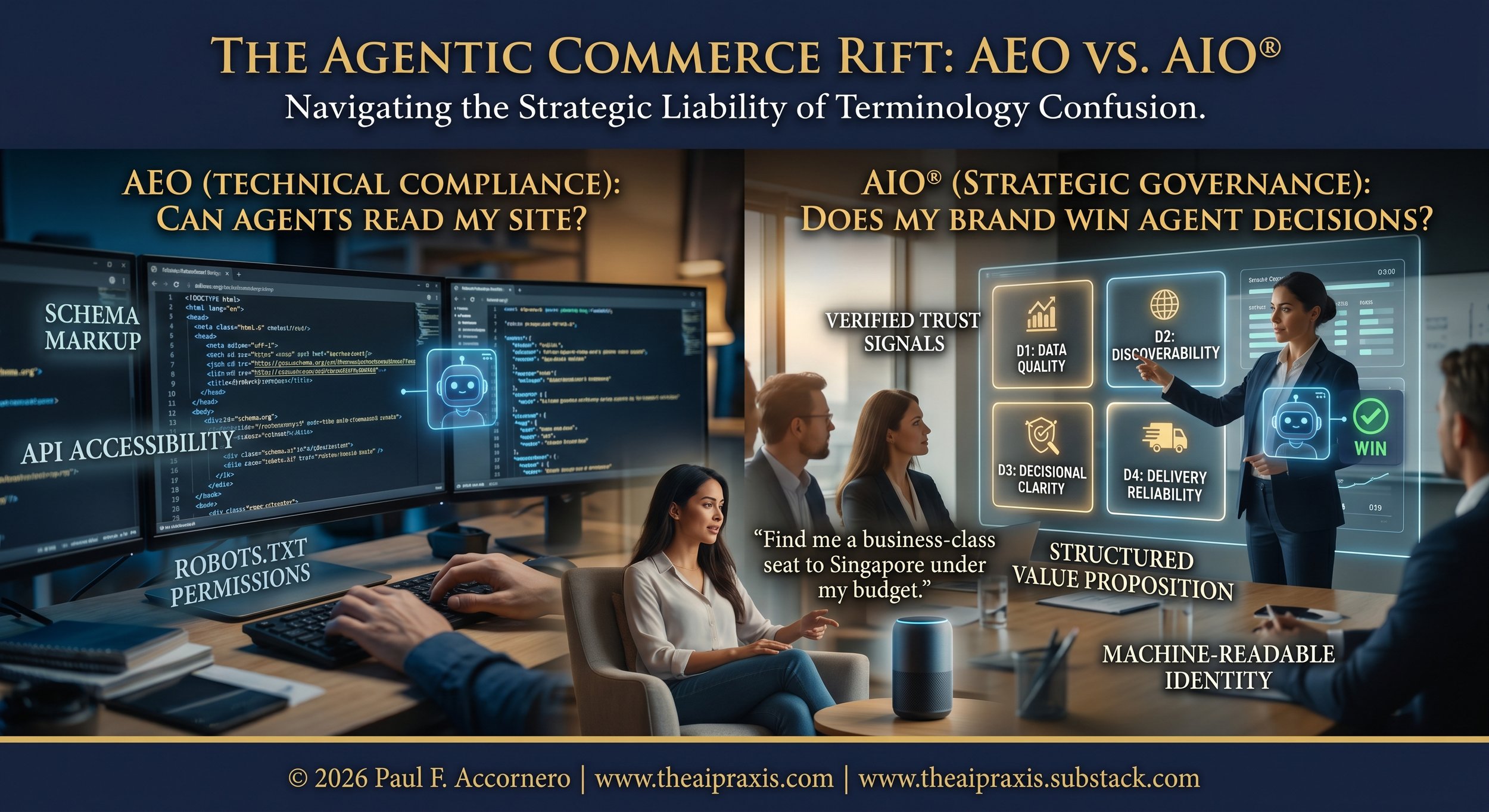
AIO vs AEO: Why the Framework You Choose Will Define Your Brand's Algorithmic Future
Picture a consumer in 2026. She does not open Amazon. She does not type a search query. She asks her AI agent to reorder her household staples.
What determined the outcome? Not your packaging. Not your ad creative. Not even your price, in the way you have historically managed it. What determined the outcome was the information your brand made available to that agent, the trust signals it could verify, and the structured data it could parse in milliseconds.
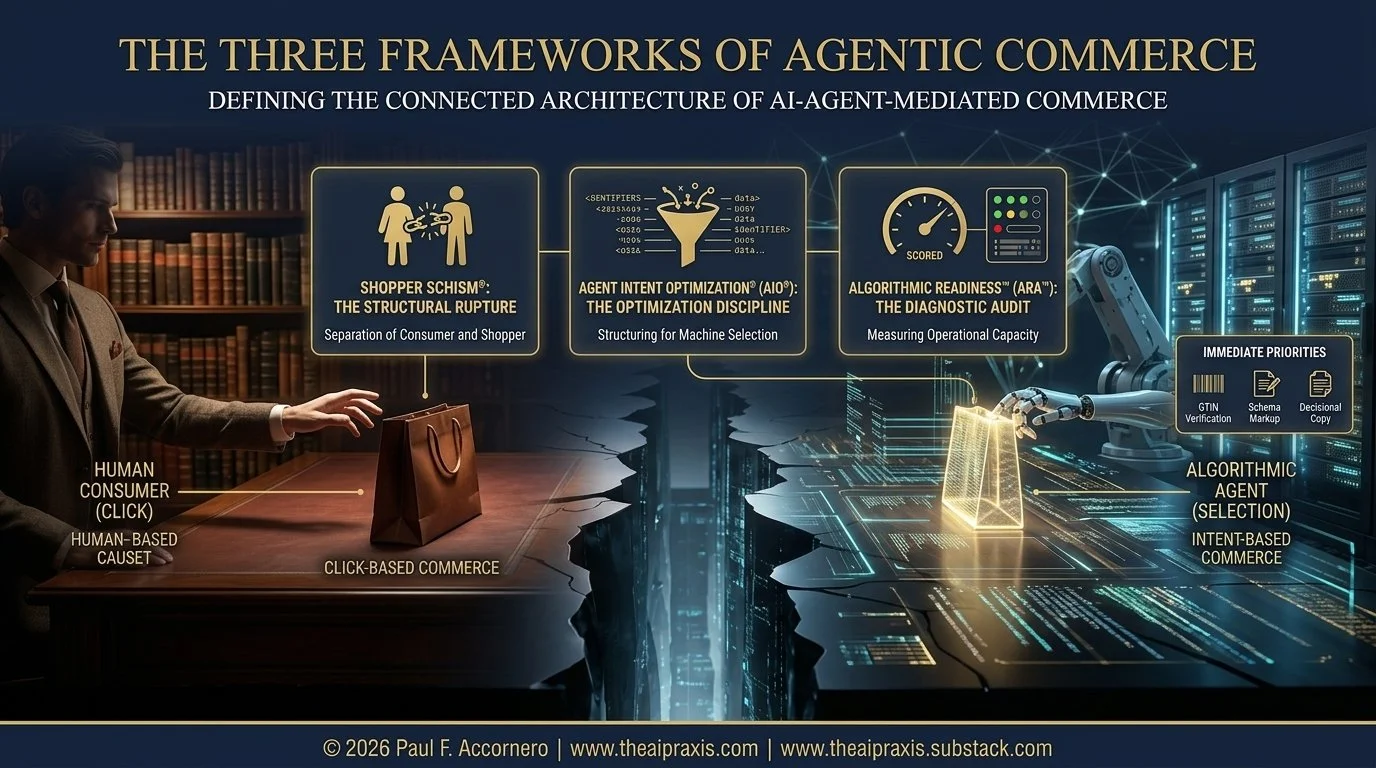
The Three Frameworks of Agentic Commerce: Shopper Schism, Agent Intent Optimization, and Algorithmic Readiness
McKinsey projects $1 trillion in US B2C revenue will be orchestrated by AI agents by 2030. The human click, the foundational unit of digital marketing for thirty years, is becoming optional.
Three frameworks explain what this shift means structurally, what it demands operationally, and why most brand organizations are unprepared. The Shopper Schism® names the rupture. Agent Intent Optimization® (AIO®) names the discipline that replaces SEO. The Algorithmic Readiness™ framework names the diagnostic. Together they form a connected architecture, not a list of concepts. Together they describe the complete commercial problem and the complete organizational response.
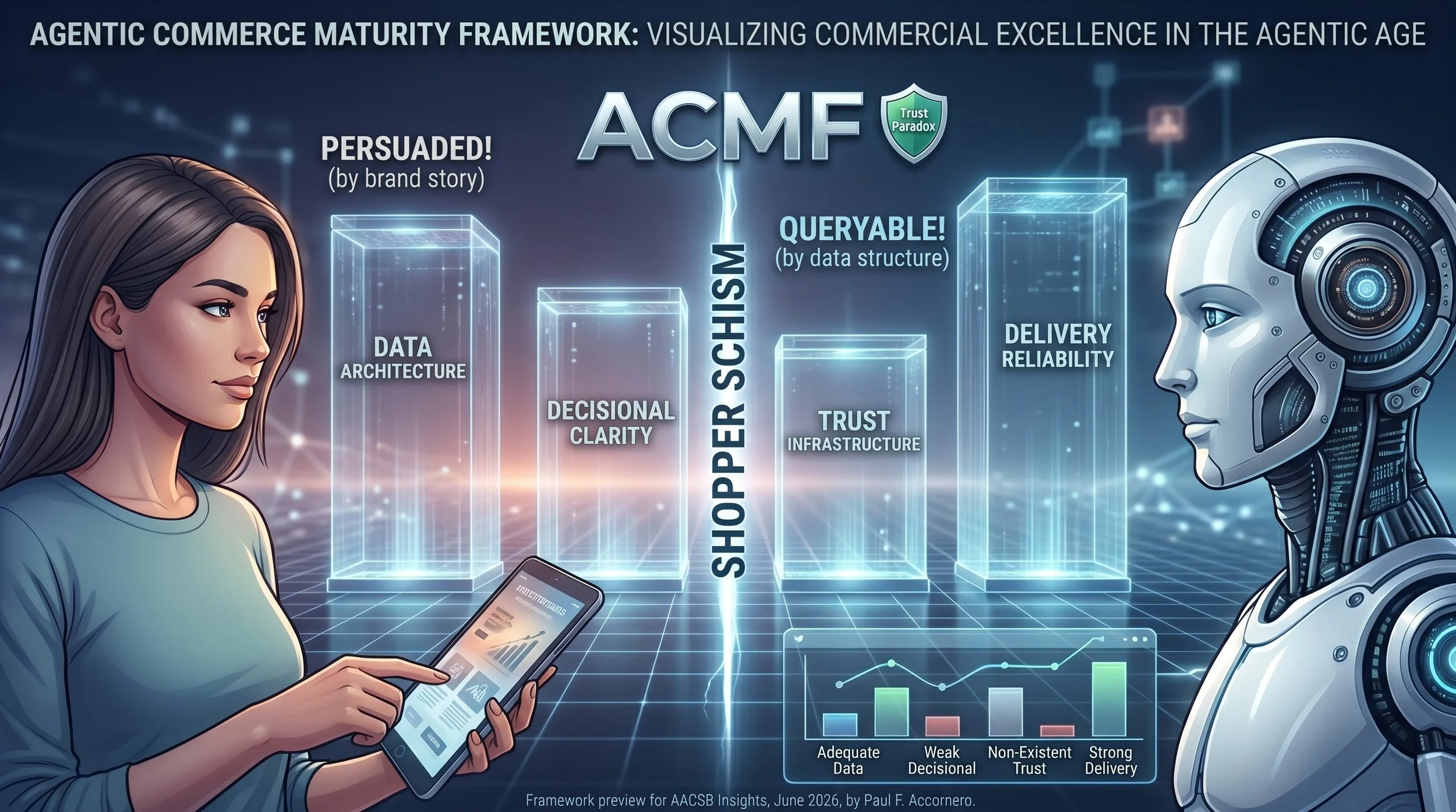
Commercial Excellence in the Agentic Age: A Preview of the AACSB Insights Framework
In June 2026, AACSB Insights will publish a framework I have been developing for two years. It addresses a question that most commercial organisations are not yet asking: what does commercial excellence look like when the buyer is not human?
The framework is the Agentic Commerce Maturity Framework, and it emerged from a specific frustration. Every diagnostic tool available to commercial leaders today assumes a human decision-maker at the centre of the purchase process.

Google’s Universal Commerce Protocol: An Analysis Through the Lens of Agentic Commerce Theory
Agentic commerce is the paradigm of commercial exchange in which autonomous AI systems, operating on delegated authority from human principals, assume the shopper function - executing search, evaluation, and purchase decisions through computational logic rather than psychological influence.

The Automaton Economy (Part 3): The Hybrid Economic Engine
Building on the foundational principles from Part 2, this article details the operational core of the Automaton Economy. I propose a resilient, three-layered hybrid model. The foundational layer is a Resource-Based Economy that uses AI to provide all necessities for free. The social layer is a digital gift economy where reputation, not money, is the currency for creative and intellectual work. The final layer is a dynamic market of worker-owned cooperatives for innovation. This is the engine of a post-scarcity world.
The Automaton Economy (Part 2): The Four Pillars of a Post-Work Society
In Part 1, we established why AI-driven automation makes our current economic system unviable. Now, in Part 2 of "The Automaton Economy," we begin the work of construction. This article outlines the four foundational principles required for a stable and prosperous post-work society: de-linking survival from labor, shifting production from profit to use, establishing democratic control over automated systems, and integrating ecological sustainability as a core economic goal. These pillars form the constitutional bedrock for a new social contract fit for the 21st century.

The Automaton Economy (Part 1): The Inevitable Obsolescence of Capitalism
This article launches a new series, The Automaton Economy, which confronts the most critical question of our time: What happens when AI makes mass human labor obsolete? We begin by diagnosing the terminal illness of our current economic system. I argue that AI automation creates a fatal paradox of production without consumption, leading to a systemic death spiral. This post deconstructs the inadequacy of patchwork solutions like Universal Basic Income (UBI) and establishes the urgent need to architect a new socio-economic model built for an age of intelligent machines.

The Great Disruptor: Is the Influencer Industry's Time Up?
The influencer industry is on the verge of its greatest disruption. This article explores why the old playbook of persuasion, built on human psychology, is becoming obsolete in an age of algorithmic shoppers and why the new king of influence will be the expert.

The Shot Heard 'Round the Gardens: An Analysis of Amazon's Withdrawal from Google Shopping and the Dawn of Agentic Commerce (Part 1 of 3)
Amazon's quiet withdrawal from Google Shopping is the first shot in an agentic turf war that signals the dawn of a new era. This analysis reveals why this move proves 'The Great Decoupling' is here and what it means for your brand when your new customer is a machine.