Google’s Universal Commerce Protocol: An Analysis Through the Lens of Agentic Commerce Theory
Why UCP validates the Shopper Schism framework — and what it means for the firms that aren’t ready
On January 11, 2026, at the National Retail Federation’s annual conference, Google announced the Universal Commerce Protocol (UCP) - an open standard for AI agent-based shopping, co-developed with Shopify, Etsy, Wayfair, Target, and Walmart, and endorsed by more than 20 additional companies including American Express, Mastercard, Visa, Best Buy, and Zalando.
This essay analyses UCP through the theoretical framework I’ve developed across my research programme on agentic commerce. The argument is straightforward: UCP is not merely a technology announcement. It is the infrastructural realisation of a structural transformation in commercial exchange that I have been documenting since 2024.
Definition Box
What is agentic commerce?
Agentic commerce is the paradigm of commercial exchange in which autonomous AI systems, operating on delegated authority from human principals, assume the shopper function - executing search, evaluation, and purchase decisions through computational logic rather than psychological influence.
What is the Shopper Schism?
The Shopper Schism is the structural disaggregation of the consumer role (who experiences utility from products) from the shopper role (who executes search, evaluation, and transaction) that occurs when AI agents assume purchasing authority on behalf of human principals.
What is Agent Intent Optimisation (AIO)?
Agent Intent Optimisation (AIO) is the successor discipline to SEO — optimising products and services for algorithmic selection rather than human search. Where SEO addresses human search behaviour, AIO addresses computational decision logic.
SEO vs GEO vs AIO?
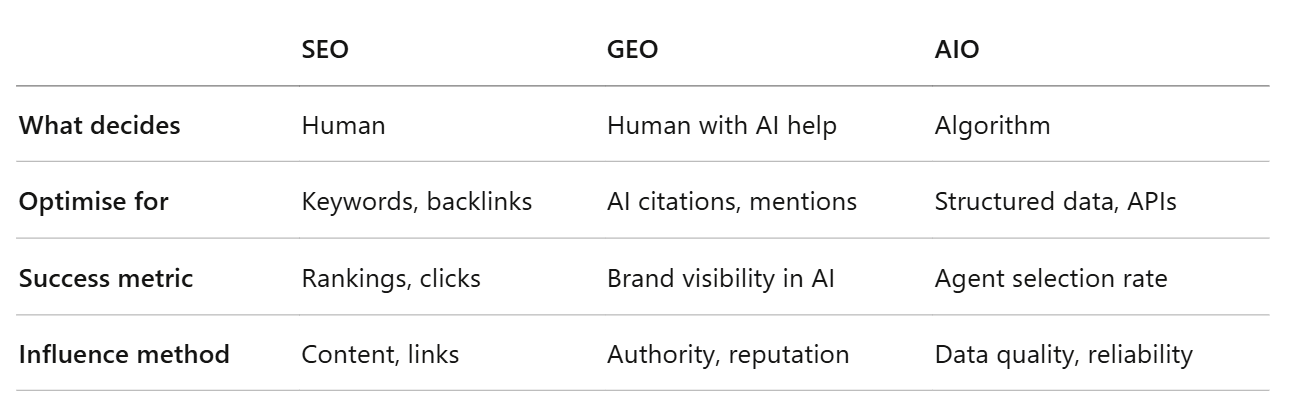
SEO vs GEO vs AIO comparison table
The Theoretical Framework
My research programme is built on a foundational observation: for a century, the architecture of commerce has rested on the fusion of two roles within a single human actor — the consumer who holds a need and the shopper who executes the purchase. I call the disaggregation of these roles The Shopper Schism™.
The Schism generates several interconnected theoretical constructs: Delegated Consumption (the principal-agent dynamics of human-to-algorithm delegation), Agent Intent Optimisation (the successor discipline to SEO for algorithmic selection), the Trust Paradox (the predictable erosion of trust as platforms monetise agent intermediation), Algorithmic Readiness (the organisational capabilities required for agent-mediated markets), and the Automaton Economy (the macro-level market dynamics when algorithms transact with algorithms).
Google’s UCP announcement maps to each of these constructs with remarkable precision.
UCP as Shopper Schism Infrastructure
UCP establishes a shared language between AI agents and commerce systems, removing the need for custom integrations. It enables agents to discover products, authenticate users, request pricing, and complete transactions autonomously. The protocol explicitly assumes that the entity executing the transaction is not human - it is a computational agent operating on delegated authority.
This is the Shopper Schism encoded in protocol architecture. Google is building the technical layer that separates the “wanting” (which remains human) from the “buying” (which becomes algorithmic). The three dimensions of separation I describe in my framework - functional, temporal, and informational - are each addressed by UCP’s design:
Functional separation is the protocol’s raison d’être: different systems handle different functions. Temporal separation is inherent in agent speed versus human deliberation. Informational separation is built into the asymmetry between what the agent can query and what the consumer can observe.
AIO Validated: The End of Keyword Commerce
The most commercially significant detail in Google’s announcement is the introduction of “dozens of new data attributes in Merchant Center” designed for “easy discovery in the conversational commerce era.” These attributes go “beyond traditional keywords” to include structured information: answers to product questions, compatible accessories, substitute products.
This is a direct operational confirmation of Agent Intent Optimisation. In my SSRN paper “From SEO to AIO” (ssrn.com/abstract=5511758), I argue that as purchase decisions shift from human consumers to autonomous agents, firms must shift from optimising for human attention (SEO) to optimising for algorithmic selection (AIO). The three strategic imperatives I identify - algorithmic visibility, algorithmic persuasion, and algorithmic relationship-building - are precisely what Google’s Merchant Center update demands.
The firms that have invested in structured data, API accessibility, and real-time operational accuracy will be discovered by agents. The firms that have not will be invisible.
The Trust Paradox in Real Time
Google’s Direct Offers feature - allowing advertisers to surface exclusive discounts when AI detects purchase intent - is the first large-scale implementation of what I describe as the Shadow Principal mechanism. The Shadow Principal is the undisclosed commercial objective embedded in agent design that operates below user awareness.
In my framework, the Trust Paradox follows a predictable lifecycle: platforms gain adoption through utility, then introduce monetisation that misaligns agent recommendations with user interests, then face trust collapse when the misalignment is exposed. Google’s simultaneous launch of UCP (utility) and Direct Offers (monetisation) compresses Phases 1 and 2 into a single product cycle.
This is not a critique of Google’s strategy. It is an observation that the structural pressures my framework predicts are manifesting exactly as theorised.
Implications for Commercial Strategy
The practical implications are substantial and immediate. I detail these in my “Algorithmic Readiness” framework (ssrn.com/abstract=5693863), but the essential points are:
First, marketing must become a data engineering discipline. If the path to purchase is now an API call, then API quality, speed, and comprehensiveness become mission-critical marketing assets. Slow, incomplete, or poorly-structured APIs are the new equivalents of retail stock-outs.
Second, brand strategy must operate on two fronts simultaneously. You must still build the brand that inspires human intention (because humans still decide what to delegate). But you must also architect the data infrastructure that wins algorithmic selection (because agents decide what gets purchased).
Third, governance and transparency must be addressed before they become regulatory mandates. The EU’s AI Act, the Digital Markets Act, and emerging US regulatory frameworks will increasingly scrutinise algorithmic intermediation. Firms that build verifiable, transparent systems now will hold competitive advantage as regulation tightens.
The Research Programme
This analysis draws on my ongoing research programme, which includes 16 papers on SSRN (top 4% of authors globally), multiple submissions to CABS 3★ and 4★ journals, an accepted publication in California Management Review (FT50), and a forthcoming article in AACSB Insights reaching 950+ business school deans worldwide.
The complete theoretical architecture is presented in my consolidated paper “Agentic Commerce: A Theory of Markets When the Shopper Is No Longer Human” (SSRN, January 2026), and will be expanded in my book The Algorithmic Shopper, forthcoming from St. Martin’s Press.
“The infrastructure is being built. The theory exists to navigate it. The question is whether your organisation is ready.”
Founder, The AI Praxis | theaipraxis.com
Subscribe to The Algorithmic Shopper, my biweekly newsletter on agentic commerce, on LinkedIn.
Explore the full research programme on SSRN: ssrn.com/author=8182896
‘The Algorithmic Shopper’ book is forthcoming from St. Martin's Press (Q1 2027). Sign up on Substack for updates.
Paul F. Accornero | Architect of Agentic Commerce Founder, The AI Praxis™ | Author, The Algorithmic Shopper (St. Martin's Press/Macmillan) Harvard Business School GMP23 | FCIM | FCMI | IoD ORCID: 0009-0009-2567-5155 | SSRN: ssrn.com/author=8182896 © 2026 Paul F. Accornero. U.S. Copyright Reg. TXu 2-507-027. All rights reserved.
About the Author
Paul F. Accornero is the Architect of Agentic Commerce — the first researcher to define the discipline where AI agents replace humans as the primary purchasing decision-makers. Creator of The Shopper Schism® and Agent Intent Optimisation (AIO)®. Author of The Algorithmic Shopper (St. Martin's Press). 30+ academic papers, top 2% of authors on SSRN.
Full Bio · Research · The Book · Newsletter
© 2026 Paul F. Accornero / The AI Praxis™. All content derived from The Algorithmic Shopper (U.S. Copyright Reg. No. TXu 2-507-027). The Shopper Schism®, Agent Intent Optimisation (AIO)®, and The Algorithmic Shopper® are registered trademarks. Full Legal & IP Terms.