
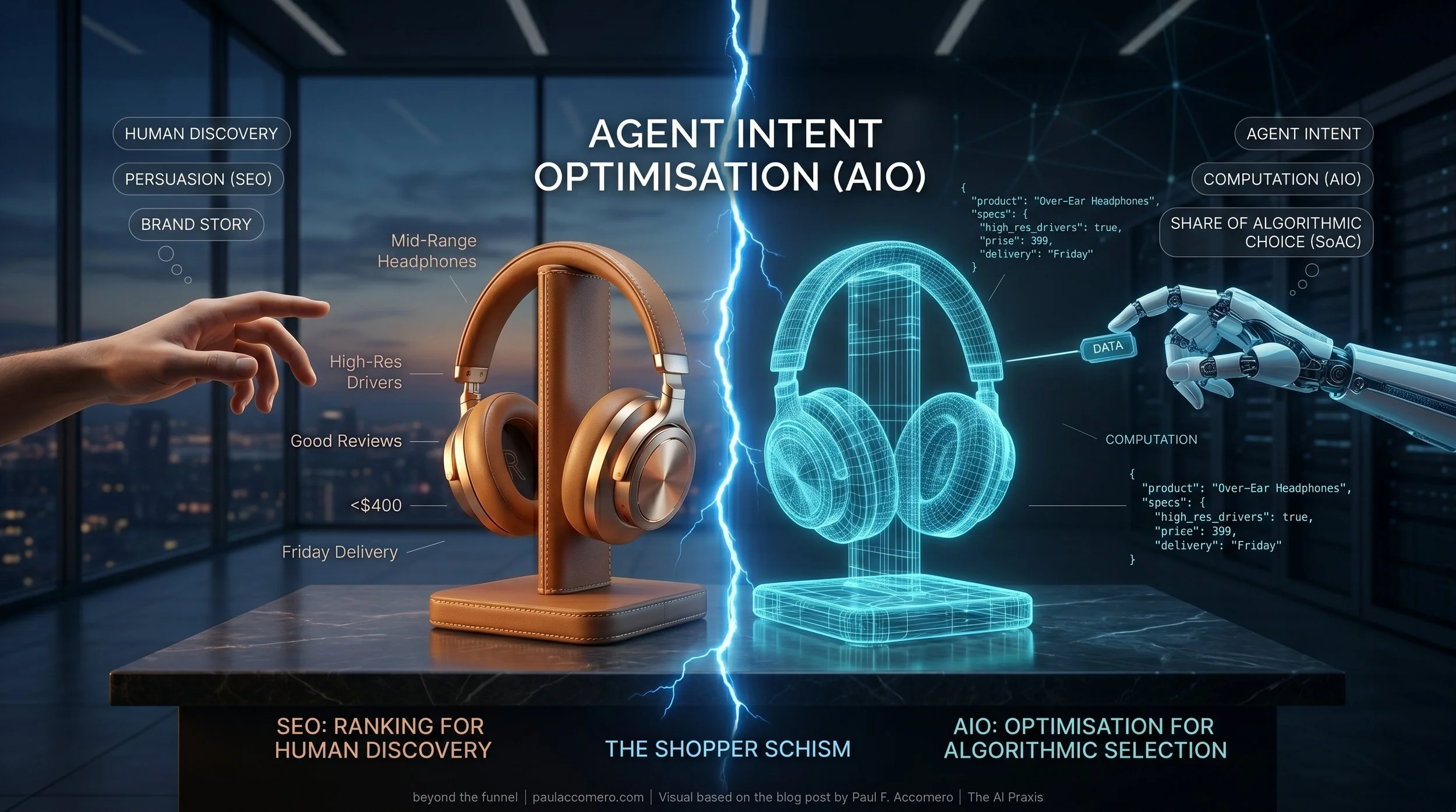
What Is Agent Intent Optimization (AIO)? The Discipline That Replaces SEO in the Agentic Commerce Era
AIO stands for Agent Intent Optimisation, the marketing discipline of optimizing products, services, content and commercial infrastructure for AI agents rather than human consumers. I coined the phrase in 2025 and published as a foundational paper on SSRN (ID: 5511758)
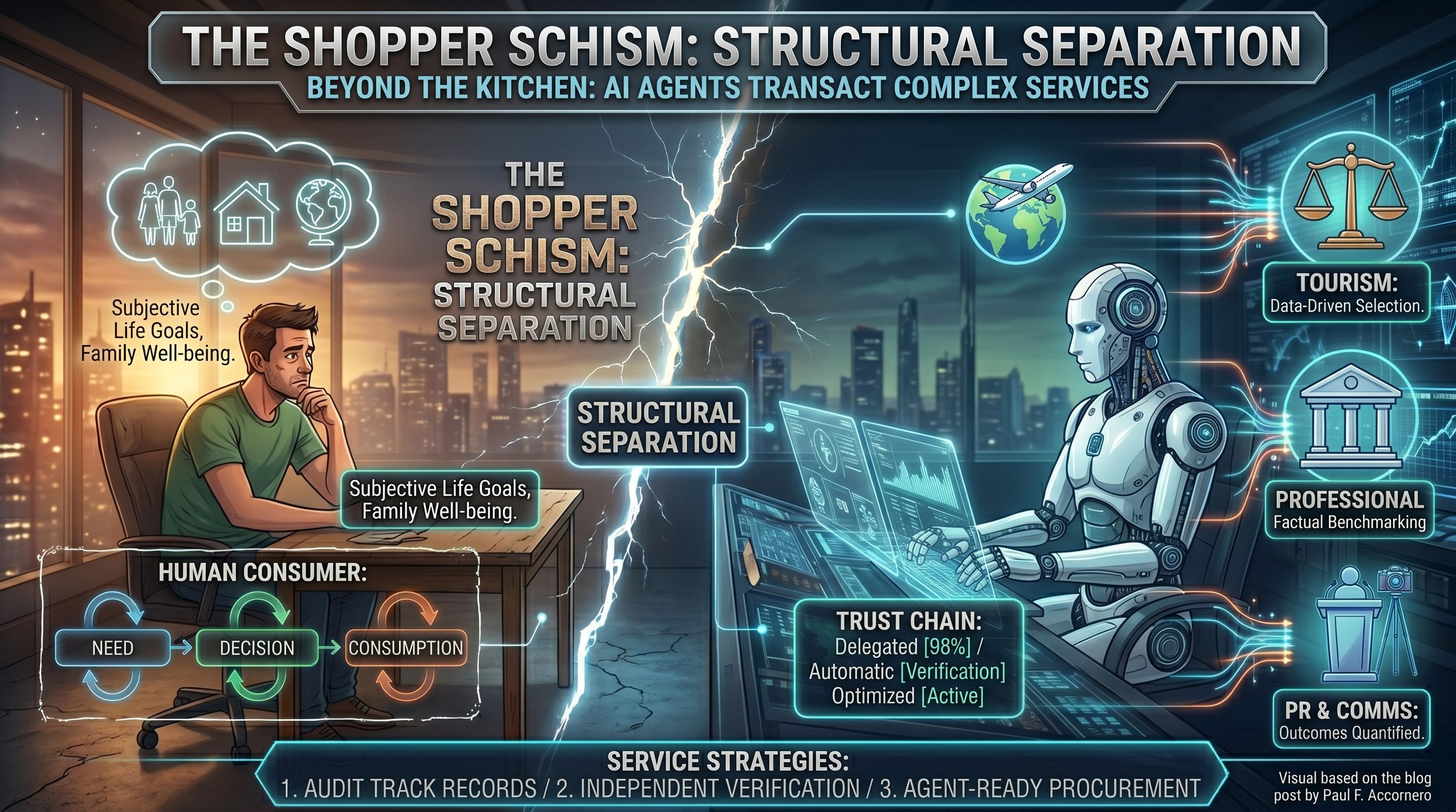
Beyond the Kitchen: Why the Shopper Schism Applies to Tourism, PR, and Professional Services
The Shopper Schism does not stop at consumer goods. Tourism, professional services, and PR are all sectors where AI agents will decompose selection criteria into structured, evaluable attributes. Paul Accornero examines how the structural separation of consumer and shopper reshapes service industries.
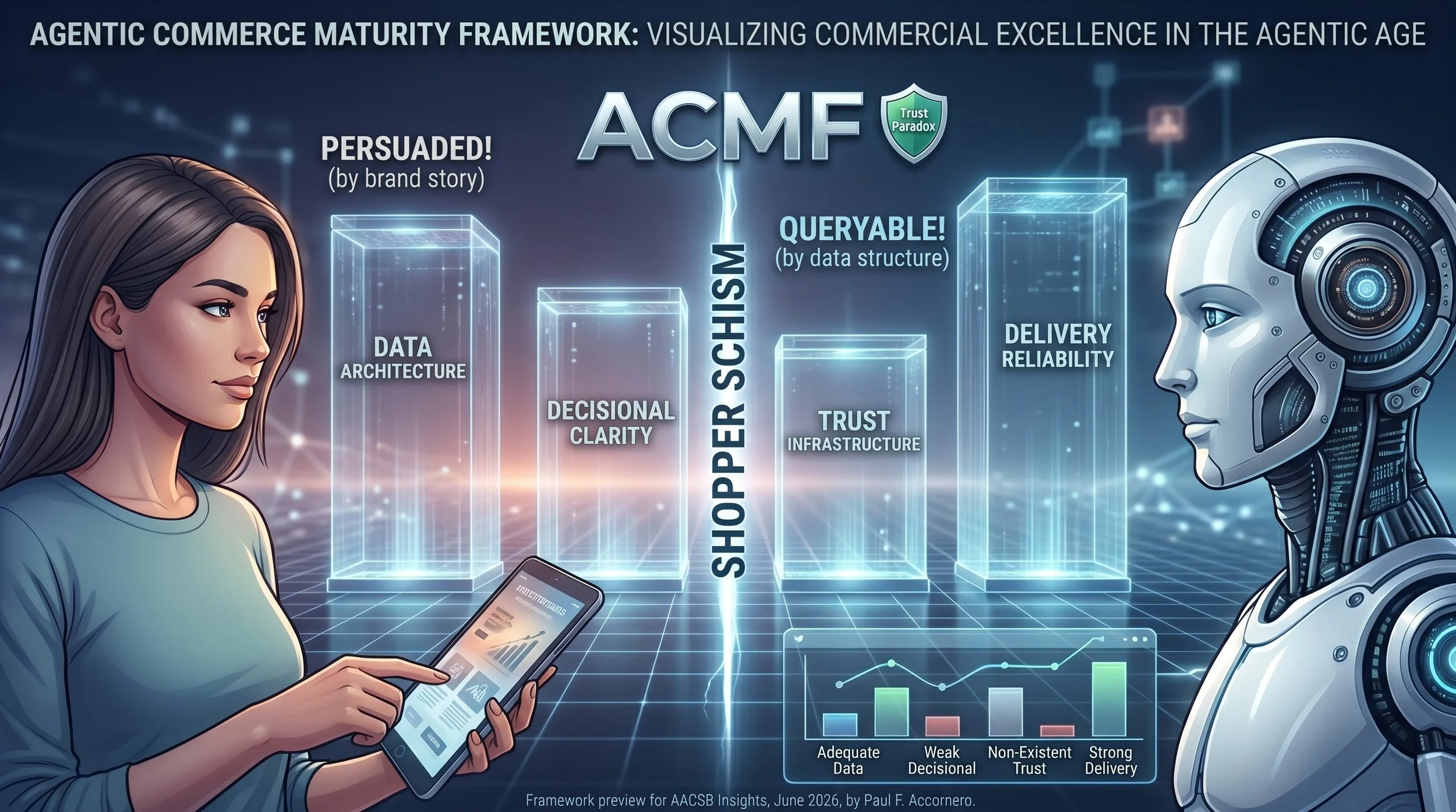
Commercial Excellence in the Agentic Age: A Preview of the AACSB Insights Framework
In June 2026, AACSB Insights will publish a framework I have been developing for two years. It addresses a question that most commercial organisations are not yet asking: what does commercial excellence look like when the buyer is not human?
The framework is the Agentic Commerce Maturity Framework, and it emerged from a specific frustration. Every diagnostic tool available to commercial leaders today assumes a human decision-maker at the centre of the purchase process.
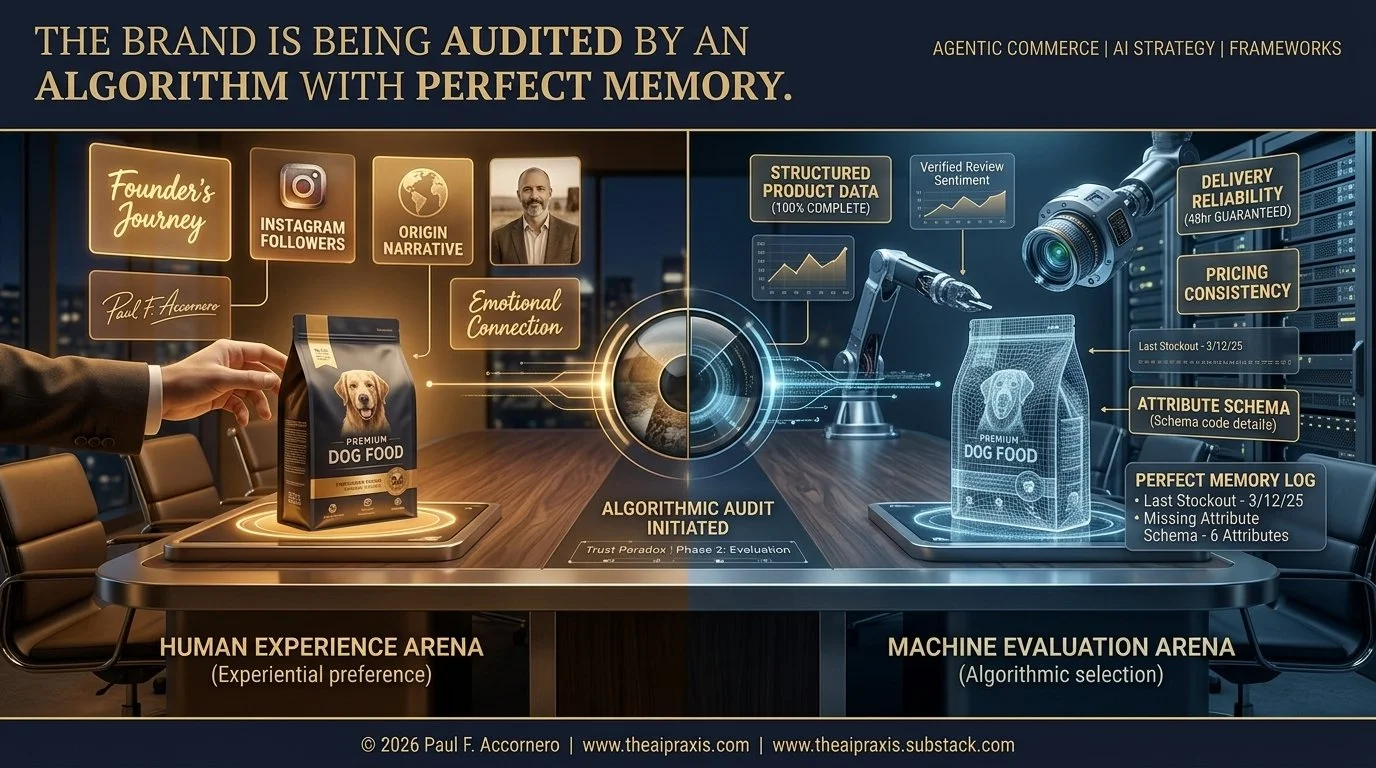
The Brand Is Not Dead. It Is Being Audited by an Algorithm with Perfect Memory.
AI shopping agents do not forget. They do not forgive. And they do not respond to brand storytelling. The Trust Paradox explains why brand trust migrates from consumer to algorithm in agent-mediated commerce. Brand trust, in the classical marketing literature, is a psychological construct. It lives in the consumer’s mind. It is built through repeated positive experiences, consistent messaging, emotional resonance, and social proof.
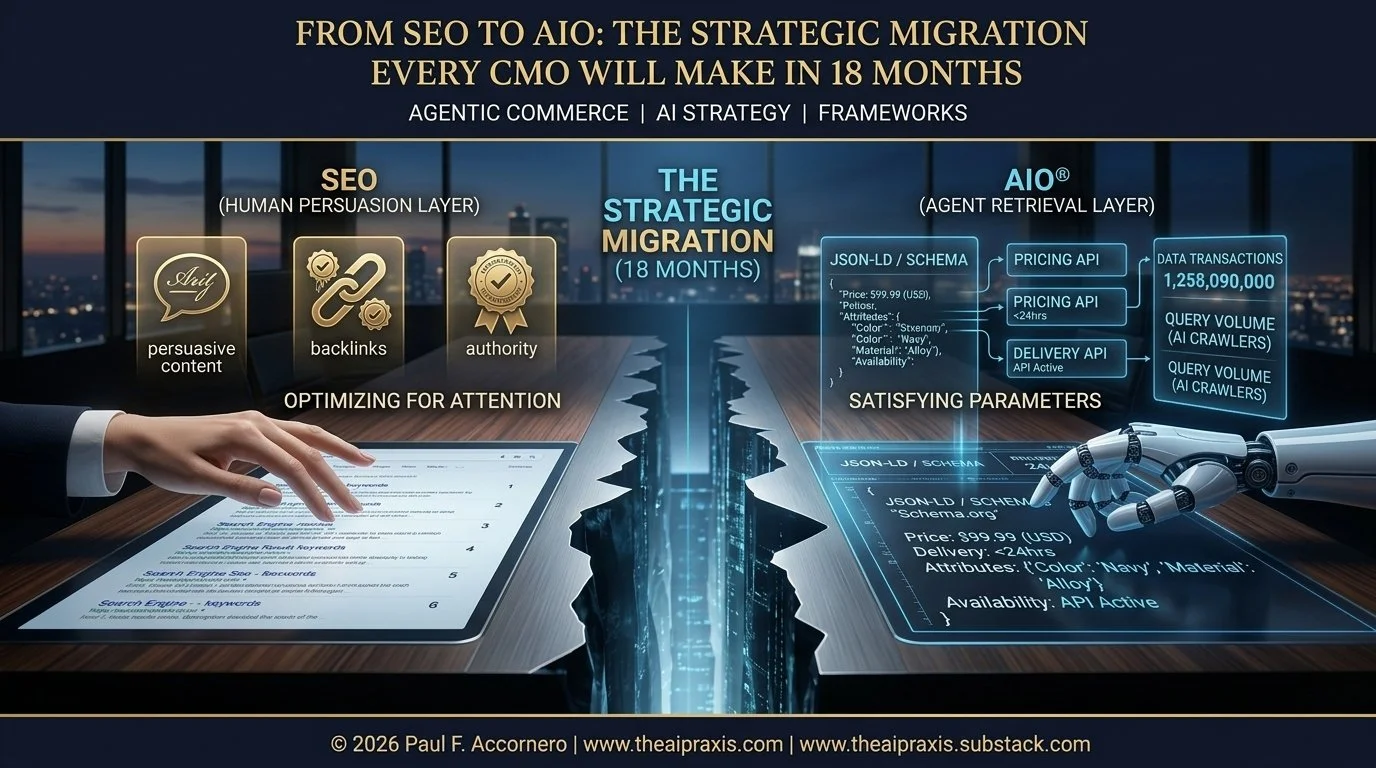
From SEO to AIO: The Strategic Migration Every CMO Will Make in 18 Months
SEO optimised for human attention. AIO optimises for machine evaluation. The migration from one to the other is not an upgrade; it is a reconstruction. Here is the structural argument and the roadmap. Every CMO in the Fortune 500 has an SEO strategy. Within 18 months, that strategy will be insufficient. Not inadequate. Not underperforming. Structurally insufficient, like optimising a telegram when the telephone has been invented.
This is not a prediction rooted in hype. It is a structural argument grounded in what AI agents actually do when they interact with commercial content. And what they do is fundamentally different from what human searchers do.
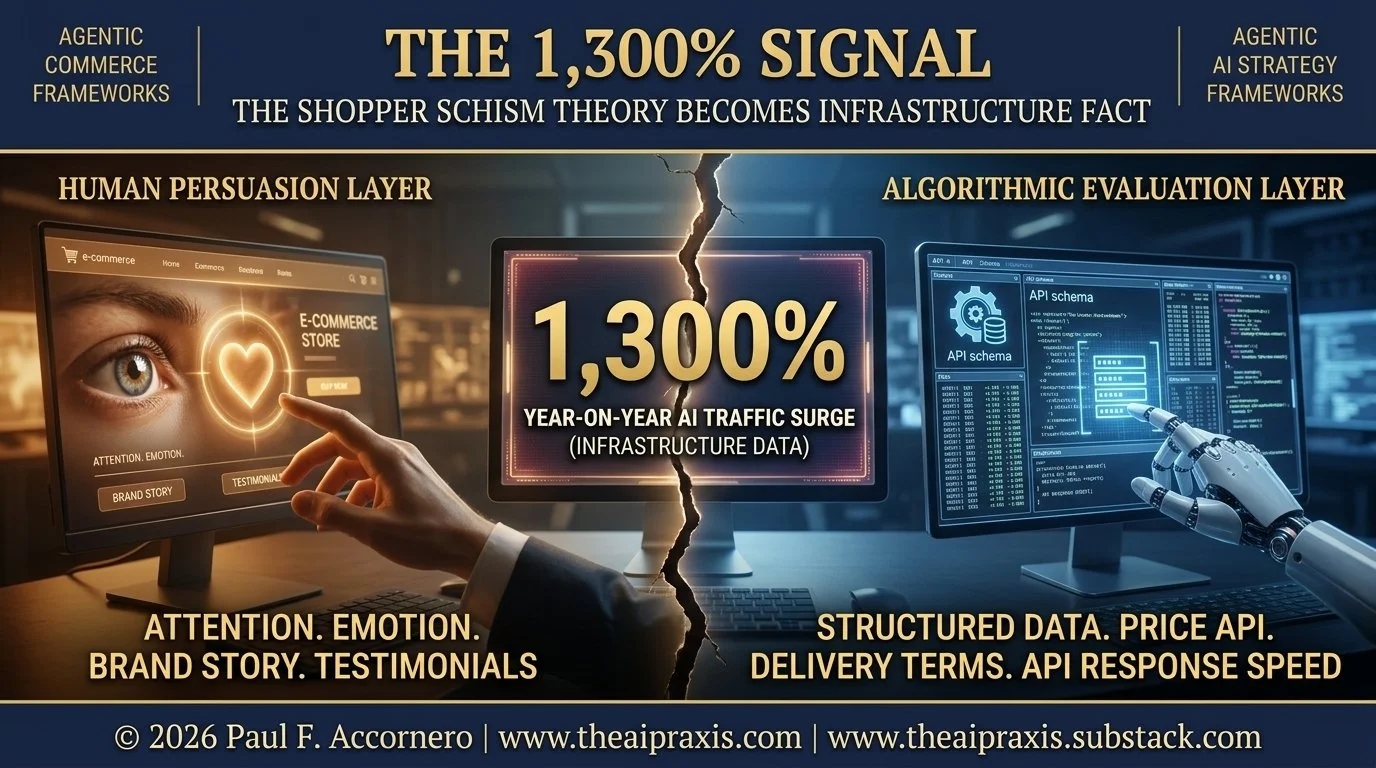
The 1,300% Signal: What ChannelEngine’s AI Traffic Surge Tells Us About the Shopper Schism
ChannelEngine reports a 1,300% surge in AI-agent traffic. Invisible launches an Agentic Commerce Adapter. Genstore ships AI-native storefronts. The Shopper Schism is no longer theoretical. It describes a structural separation: the permanent disaggregation of the human consumer who experiences a product from the algorithmic agent that increasingly selects, evaluates, and purchases it.

13 Predictions About Agentic Commerce (And How to Falsify Them)
Testable predictions about what happens when AI agents replace human buyers. Each prediction includes the evidence that would prove it wrong. Theory, not commentary. Derived from the integrated Agentic Commerce framework.
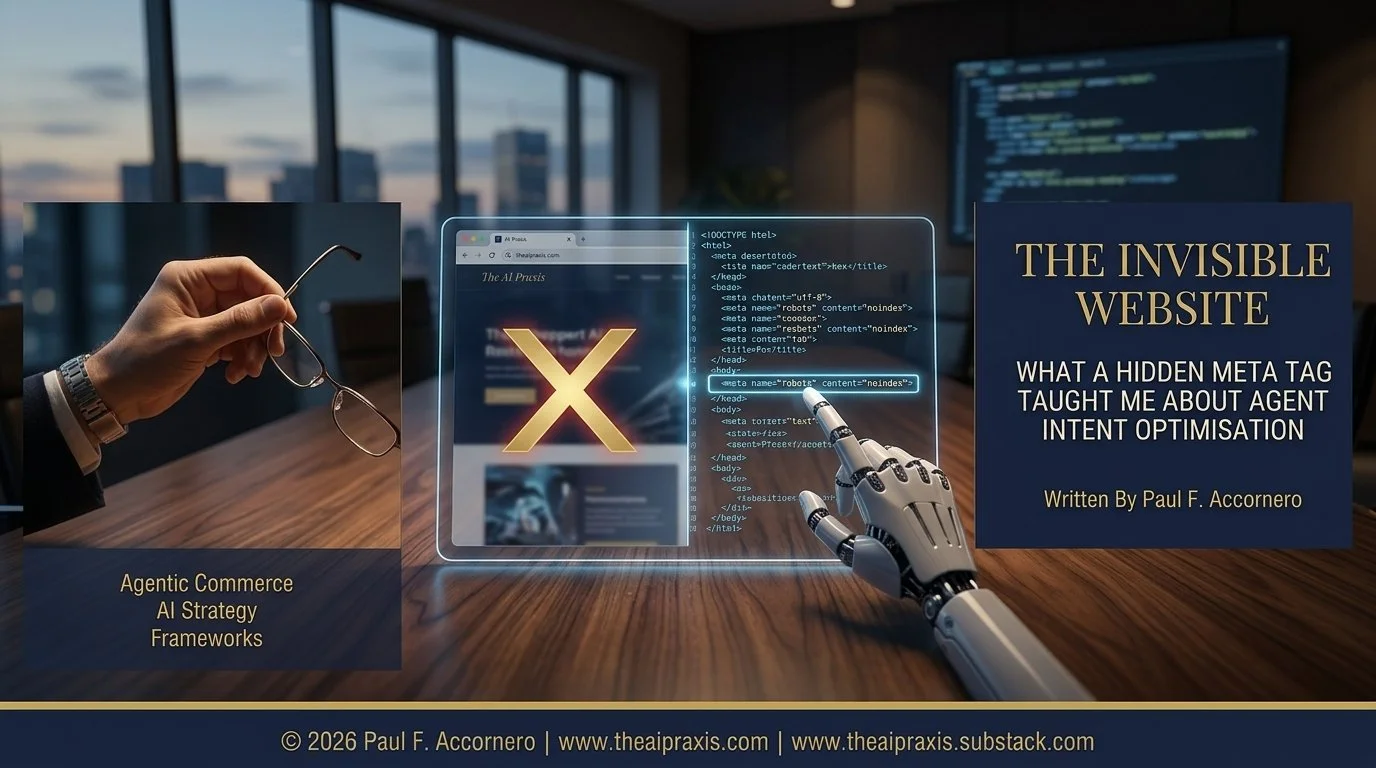
The Invisible Website: What a Hidden Meta Tag Taught Me About Agent Intent Optimisation
A hidden noindex meta tag rendered theaipraxis.com invisible for two months. The lesson is not about SEO. It is about why Agent Intent Optimisation demands a fundamentally different infrastructure posture.
Not in the way that a restaurant closes for renovations or a shop locks its doors overnight. It existed physically; the pages loaded, the text rendered, the frameworks sat there waiting for readers. But to every search engine on the planet, and to every AI agent crawling the web for information about agentic commerce, theaipraxis.com was a blank wall. Invisible. Silent. Gone. The culprit was a single line of code: <meta name="robots" content="noindex">.
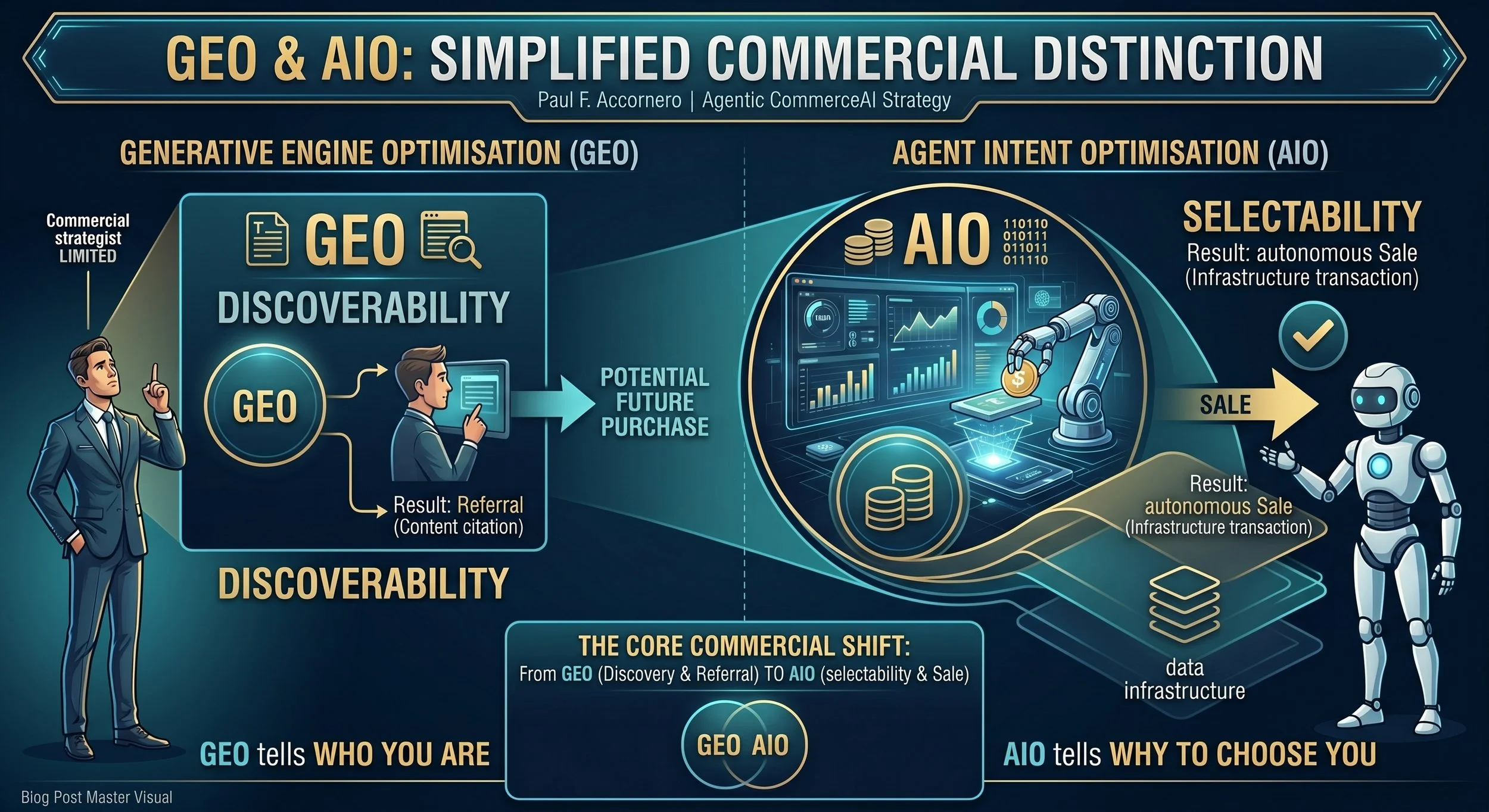
GEO, AIO, and the Question Every Commercial Strategist Is Getting Wrong
GEO optimises for AI citation. AIO® optimises for autonomous agent selection. Understand the distinction that will define commercial strategy in the decade ahead.
The marketing profession has a long tradition of adopting new acronyms faster than it develops new thinking. GEO - Generative Engine Optimisation - is the latest addition to that tradition. It describes something real and commercially important. It also creates a conceptual ceiling that, if left unexamined, will cost organisations significant revenue.
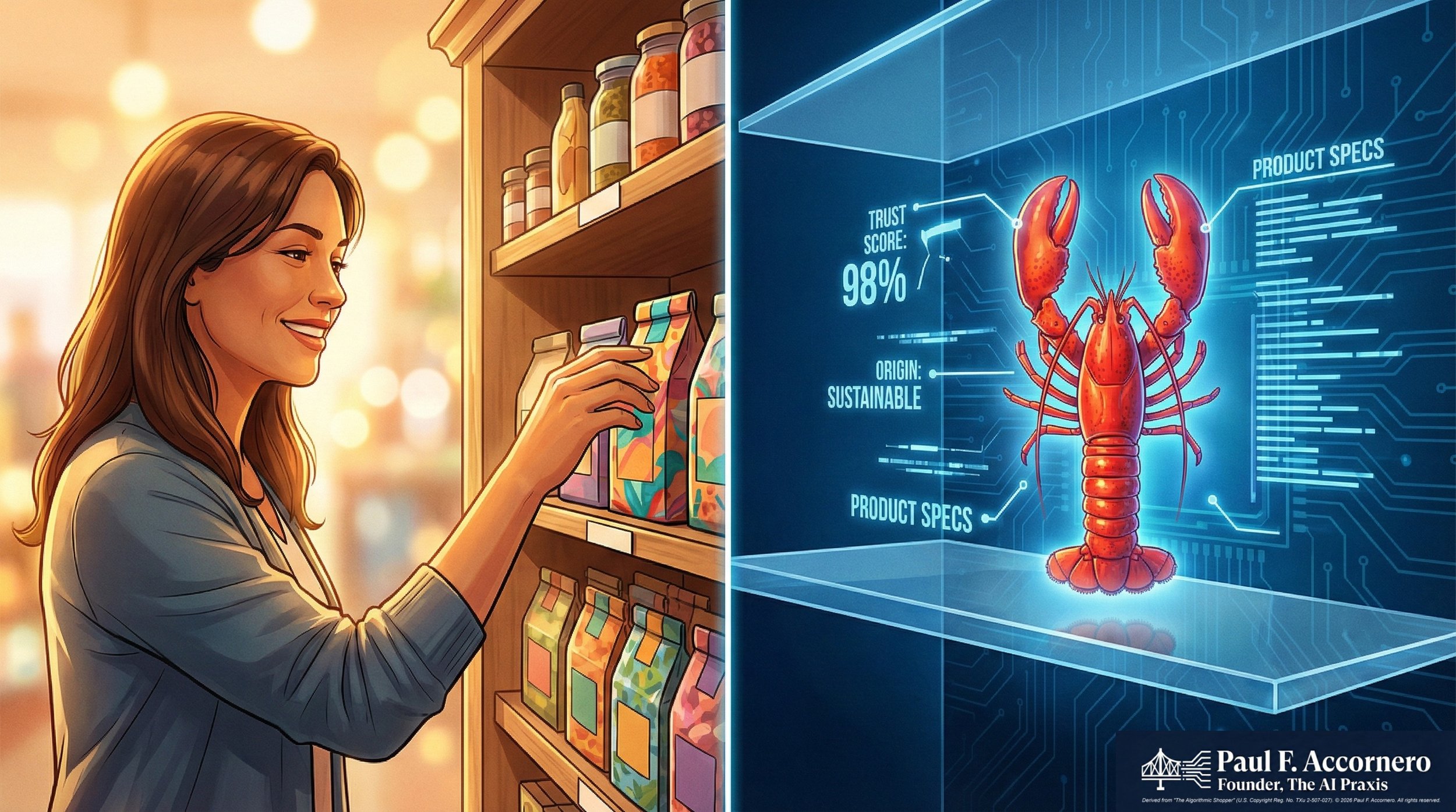
Algorithmic Readiness in the Age of Agent Reputation: Five Questions Every Commercial Leader Must Answer
1.5M+ claimed agents. Reddit-like format. Explain “molts,” “submolts,” the lobster metaphor, OpenClaw/Moltbot origins. Then the critical lens: The Economist’s “humdrum explanation” — agents may simply be mimicking social media patterns from training data. MIT Technology Review’s “AI theater” framing.

Google’s Universal Commerce Protocol: An Analysis Through the Lens of Agentic Commerce Theory
Agentic commerce is the paradigm of commercial exchange in which autonomous AI systems, operating on delegated authority from human principals, assume the shopper function - executing search, evaluation, and purchase decisions through computational logic rather than psychological influence.
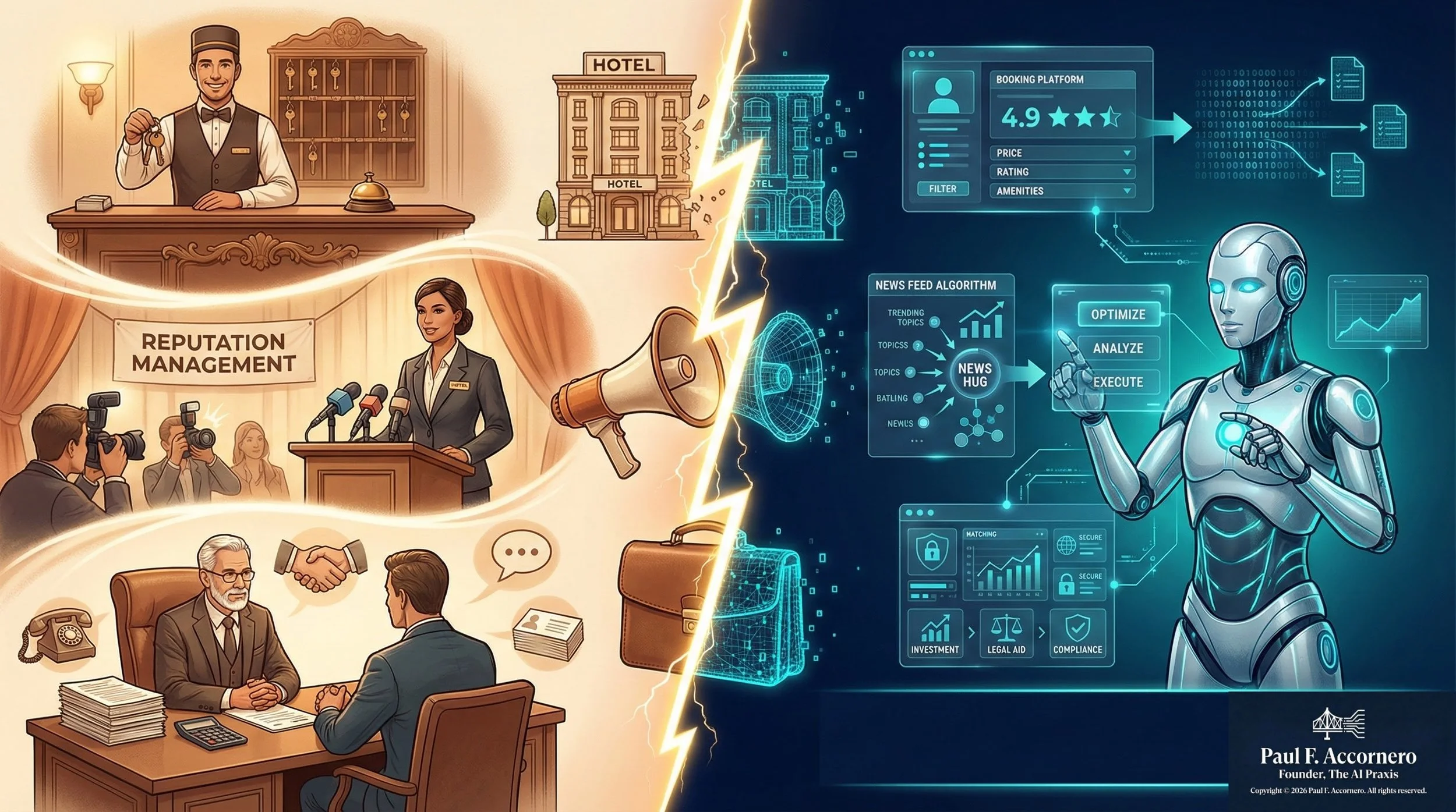
Beyond the Kitchen: Why the Shopper Schism Isn't Just About Consumer Goods
Your hotel doesn't compete for your loyalty anymore—Booking.com does. The same transformation is coming for PR, legal, financial services, and every industry that thinks it's different. New research from Paul F. Accornero.

AI Co-Pilot vs. Autopilot: The Most Dangerous Strategic Error a C-Suite Leader Can Make Today
Business leaders are investing billions in "AI" without understanding a critical distinction: the difference between a Co-Pilot and an Autopilot. One augments your current business model, making it more efficient. The other makes it obsolete by replacing the human decision-maker entirely. This article cuts through the hype to provide a clear, actionable framework for leaders , arguing that preparing for a Co-Pilot when an Autopilot like the Algorithmic Shopper is coming is a potentially fatal strategic error.

The Architects of Our New World: How Visa, Google, and Walmart Are Building the Agentic Economy
While we debate the future of AI, the agentic economy is already being constructed in plain sight by three familiar giants: Visa, Google, and Walmart. This article moves beyond analyzing them in their traditional silos to reveal their deeper strategies. Each is architecting a unique, competing "Walled Garden" for our Algorithmic Shoppers. Discover the three distinct visions—the Universal Translator, the Universal Brain, and the Universal Supply Chain—and what they mean for the future of your business.
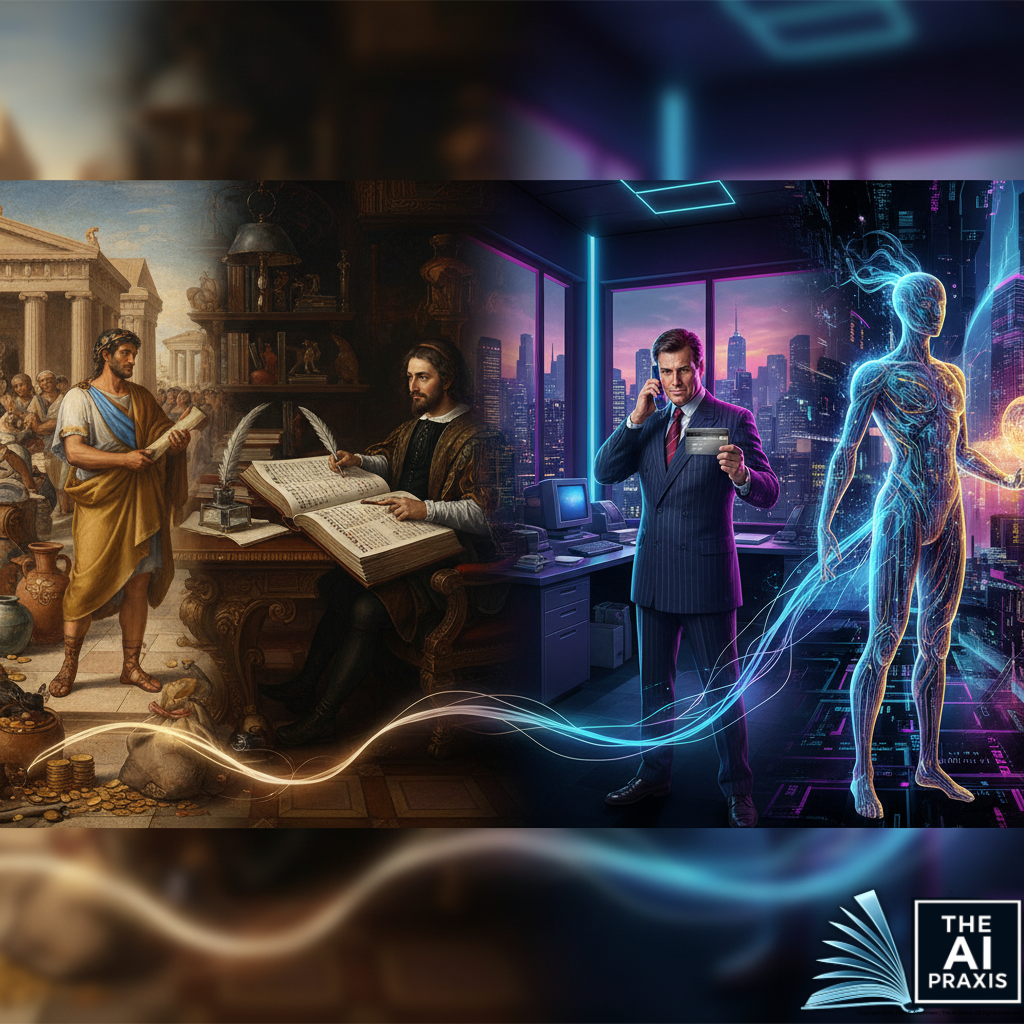
From the Agora to the Algorithm: The 7,000-Year Journey to Your Next Customer
The rise of the AI shopper seems like a radical, unprecedented disruption. But what if it's the most predictable evolution in economic history? This article traces the 7,000-year arc of "commercial abstraction," from the physical Agora to the abstract algorithm. By understanding how we've systematically delegated trust to proxies like coins, ledgers, and credit cards, we can see the Algorithmic Shopper not as a revolution, but as the final, logical step in our quest for frictionless commerce.
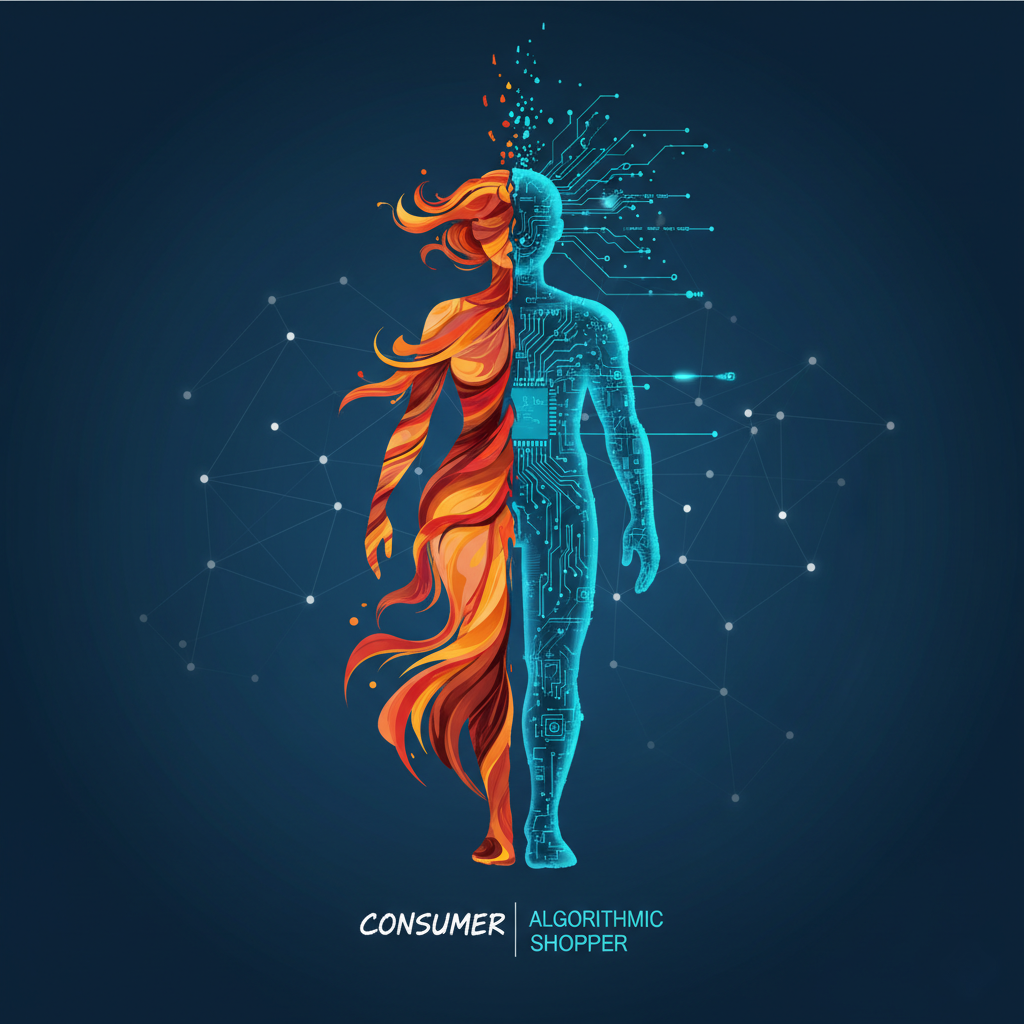
The Dog Food Dilemma: Why a Century of Marketing Is Obsolete in the AI Age
For a hundred years, marketing has focused on persuading the human shopper. But what happens when the shopper is no longer human? This article uses the classic "Dog Food Dilemma" to introduce the Shopper Schism (Great Decoupling)—the irreversible, AI-driven split between the human consumer and the transactional shopper. It deconstructs why our entire commercial playbook is becoming obsolete and what leaders must do to prepare for the age of the Algorithmic Shopper.

Foundations of a New Playbook for the Agentic Age (Part 3 of 3)
Having established the "what" (Amazon's withdrawal) and the "why" (the rise of the Algorithmic Shopper), we arrive at the final, most critical question for leadership: what must be done now? The strategic playbook developed over the last century, designed to appeal to human psychology, is now obsolete. Victory in the agentic age requires a fundamental pivot from the art of persuasion to the science of machine optimization.

The Shopper Schism™ and the Rise of the Algorithmic Shopper: When your New Customer is a Machine (Part 2 of 3)
Amazon’s multi-billion-dollar bet on the Algorithmic Shopper signals a profound shift. This is the "Shopper Schism™," where your brand is chosen not by a human, but by a dispassionate AI proxy.

The Shot Heard 'Round the Gardens: An Analysis of Amazon's Withdrawal from Google Shopping and the Dawn of Agentic Commerce (Part 1 of 3)
Amazon's quiet withdrawal from Google Shopping is the first shot in an agentic turf war that signals the dawn of a new era. This analysis reveals why this move proves 'The Great Decoupling' is here and what it means for your brand when your new customer is a machine.
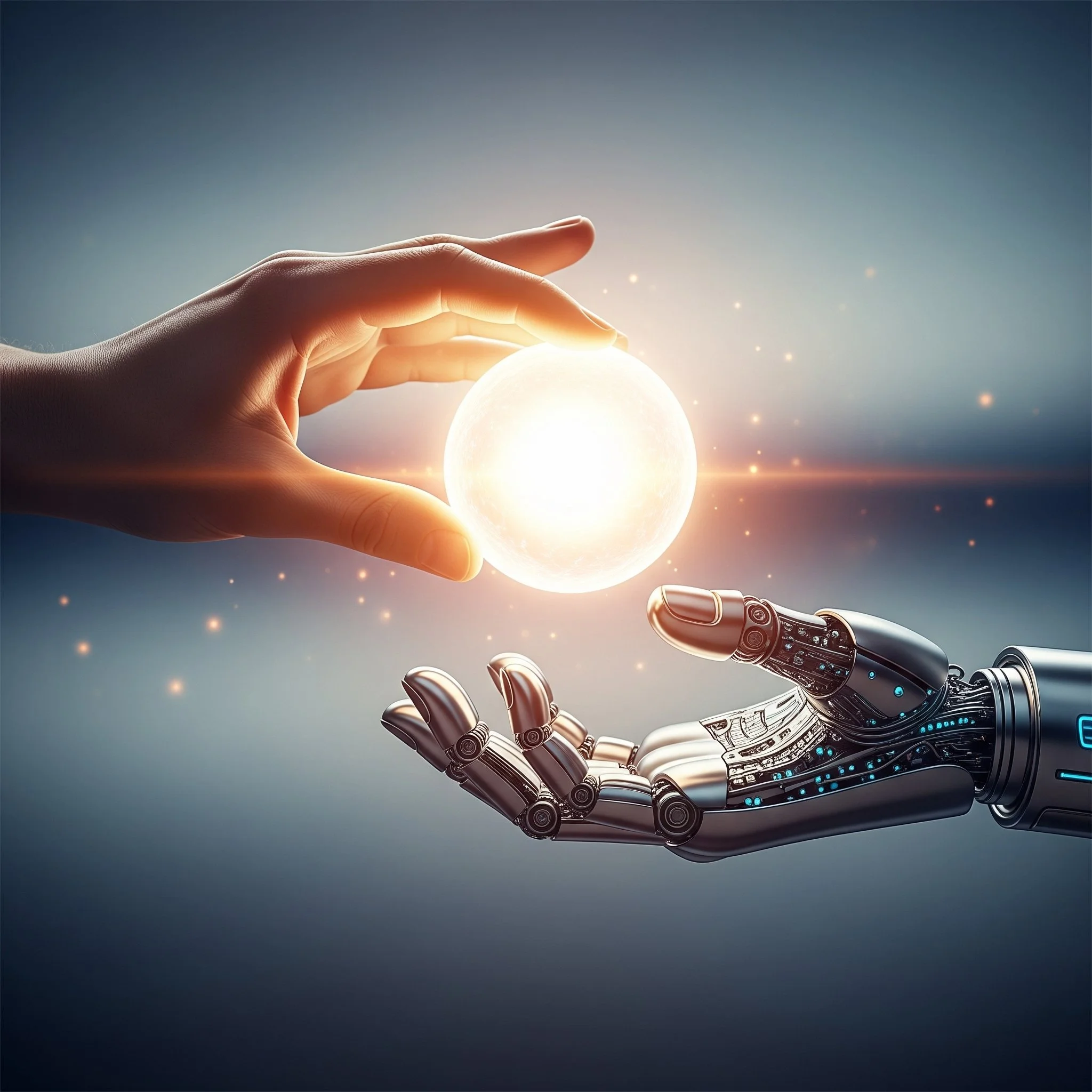
Humanity's Final Project: Parenting Our Successors
Everyone is asking if AI will take their job. I think that's the wrong question. The real question is bigger: are we building our evolutionary successors? And if so, are we being good parents? In my new article, I explore the idea that this is humanity's final and most important project. Dive in and let's discuss.